
Table of Contents
- Why Volcanic Minerals Stop Root Rot Before It Starts
- How Zeolite and Volcanic Tuff Improve Drainage and Aeration
- How to Improve Drainage in Clay Garden Soil with Volcanic Amendments
- Signs of Root Rot in Houseplants and How Minerals Reduce Risk
- Zeolite vs Perlite for Plant Roots: Which Belongs in Your Mix?
- Mixing Volcanic Minerals: Ratios by Plant Type and Long-Term pH
- Frequently Asked Questions
Last Updated: September 13, 2026
Why Volcanic Minerals Stop Root Rot Before It Starts
Root rot is a drainage failure, not a disease that strikes at random. Water sits in the root zone, oxygen disappears, and opportunistic pathogens move in. Using volcanic minerals to prevent root rot works because they restructure the potting medium itself, creating permanent channels where water drains and air circulates. This guide from Arden Line covers the mineral science, the mixing ratios, and the failure points most growers never hear about.
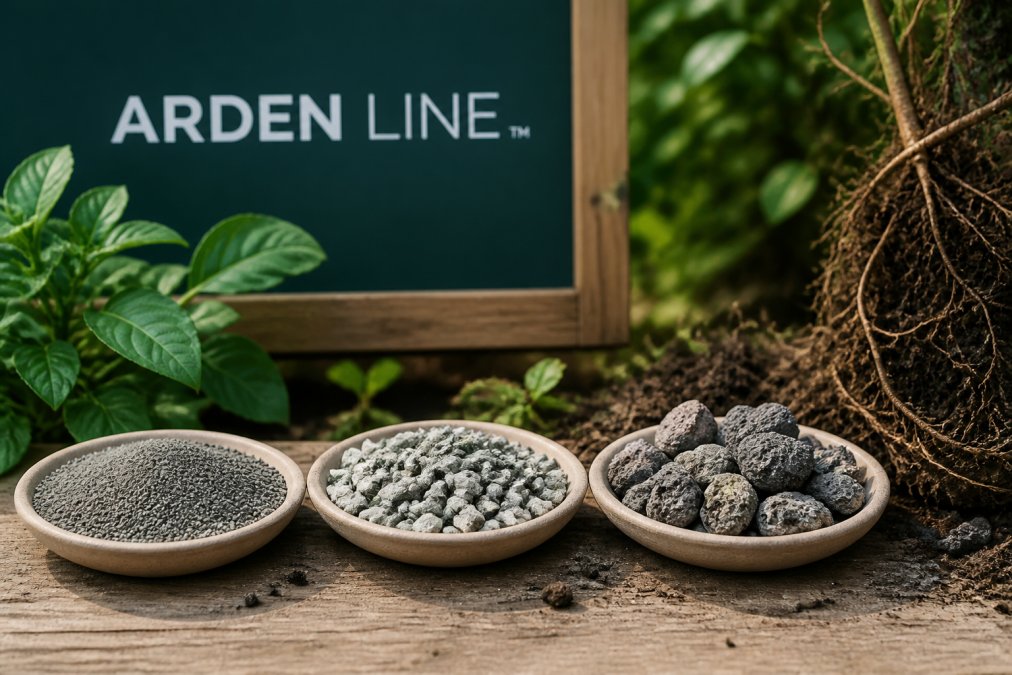
Volcanic minerals are naturally porous, mineral-rich rocks and ashes formed during volcanic activity, most commonly zeolite, volcanic tuff, and volcanic ash. Their internal structure holds thousands of tiny cavities, which is what separates them from sand or gravel.
The Root-Zone Structure Problem
Most commercial potting mixes compact within weeks of watering. As particles settle, the gaps between them collapse and the medium loses the pore space roots depend on, so water pools at the bottom of the pot where the finest roots sit.
The USDA Natural Resources Conservation Service soil health guidance describes soil structure as the arrangement of particles and pore space, and it's that arrangement, not the ingredients, that determines whether water moves or stalls.
Volcanic minerals resist this collapse. Their rigid structure keeps pores open under repeated watering, maintaining root-zone structure far longer than bark or peat alone.
How Zeolite and Volcanic Tuff Improve Drainage and Aeration
Zeolite and volcanic tuff improve drainage by holding water inside their own internal pores while leaving the spaces between particles open for airflow. Water moves through the medium instead of sitting in it, and oxygen reaches the roots continuously.
Zeolite is a crystalline mineral with a cage-like lattice structure (PubMed). That lattice gives it a high cation exchange capacity, meaning it holds onto nutrient ions like potassium, calcium, and magnesium and releases them back to the roots over time. Volcanic tuff, formed from compacted ash, is lighter and more irregular, which makes it excellent for opening up dense mixes.
Porosity, Root Respiration, and Oxygen Circulation
Roots need oxygen. When pore space fills with water for extended periods, roots suffocate and tissue breaks down, the exact condition root rot pathogens exploit.
Porosity does two jobs at once: it absorbs excess water during heavy watering and releases it slowly, and it maintains oxygen circulation so the root zone never goes fully anaerobic.
A common mistake is assuming any gritty material solves this. Fine sand compacts and reduces aeration; volcanic minerals keep their shape and their cavities.
How to Improve Drainage in Clay Garden Soil with Volcanic Amendments
Improving drainage in clay garden soil with volcanic amendments works because the minerals physically separate clay platelets that would otherwise bind together. Clay's flat platelets stack tightly and seal off the macropores water and oxygen need; rigid, irregular volcanic granules wedge between them and hold open channels that survive wetting and drying cycles.
Most clay "fixes" fail: tilling breaks structure temporarily before the soil re-compacts, and sand can make clay harder if its particles are smaller than the clay aggregates. Volcanic minerals work because their particle size and rigidity keep pores open.
Here is the practical sequence, with the numbers that matter:
- Test the actual problem first. Dig a hole roughly 12 inches deep and 6 inches wide, fill it with water, and time how long it takes to drain. If water still sits after several hours, you have a drainage issue, not just compaction. A percolation rate under about 1 inch per hour is a strong signal that amendment is warranted.
- Match particle size to your clay. For heavy clay, use 1/4-inch to 1/2-inch volcanic granules so the particles are large enough to resist being swallowed by the clay matrix. For loamy clay, 1/8-inch to 1/4-inch blends more evenly. Fine dust or powder does almost nothing for structure.
- Apply at the right depth and rate. Work volcanic amendments into the top 6 to 8 inches, where most feeder roots live. A common starting rate is 10 to 15 percent by volume of the amended zone. For a 100-square-foot bed amended to 8 inches deep, that is roughly 1 to 1.5 cubic yards of mineral. Surface scattering does almost nothing for clay.
- Combine with organic matter. Compost improves aggregation; minerals keep the aggregates from collapsing. Together they outperform either alone. A typical blend is two parts native clay soil, one part finished compost, and one part volcanic mineral by volume.
- Reapply gradually. Clay soils respond over seasons, not days. A light annual topdressing of 1/4 to 1/2 inch, scratched into the surface, beats a single heavy dose that can create a textural discontinuity.
For containers, the same logic applies at a smaller scale. Arden Line's Zeolite Mineral Lava Rocks are sized at 1/8" to 1/4", blending evenly into potting medium without settling into a layer. In-ground beds usually want the coarser granular grade so particles stay put through freeze-thaw cycles.

A note on timing: amend in early fall or early spring, when soil is workable but not saturated. Working wet clay destroys the structure you are trying to build, and the minerals cannot compensate for smeared, compacted subsoil.
Signs of Root Rot in Houseplants and How Minerals Reduce Risk
The signs of root rot in houseplants are easy to misread because the top of the plant looks thirsty while the roots are drowning. Yellowing lower leaves, a soft stem base, stalled growth, and soil that stays damp for days all point to the same cause.
The tell is smell. Healthy roots smell earthy. Rotting roots smell sour or spoiled. If you slide the plant out of its pot and the roots are brown and slip off their core, the diagnosis is confirmed.
Minerals reduce risk by removing the conditions pathogens need. Prevention depends on oxygen and drainage, not chemical treatment: when the root zone stays aerated, rot organisms lose their advantage.
Zeolite vs Perlite for Plant Roots: Which Belongs in Your Mix?
The short answer: perlite is for drainage, zeolite is for drainage plus nutrient and moisture management. Perlite is expanded volcanic glass, lightweight, sterile, good at one job. Zeolite does that job while also holding and gradually releasing nutrients. But neither is simply better: each has failure modes, and the right pick depends on your watering habits, pot size, and how long the plant stays in the same mix.
| Property | Zeolite | Perlite |
|---|---|---|
| Origin | Volcanic mineral (clinoptilolite) | Expanded volcanic glass |
| Primary function | Drainage, aeration, nutrient retention | Drainage and aeration |
| Cation exchange capacity | High | Negligible |
| Moisture behavior | Absorbs and releases slowly | Drains freely, holds little |
| Weight | Heavier, stays in place | Very light, floats to surface |
| pH effect | Near-neutral, buffers slightly | Neutral, inert |
| Best for | Long-term container mixes, clay soils | Seed starting, light mixes, propagation |
When Perlite Is the Better Choice
Perlite wins in three situations: seed starting and propagation, where seedlings need consistent moisture without nutrient-holding capacity that can burn tender roots; very light mixes for epiphytes and orchids, where weight matters and the mix is replaced often; and setups where you want fast, predictable drainage and feed with a complete liquid fertilizer, making nutrient retention redundant.
When Zeolite Wins
Zeolite wins when the plant stays in the same pot for a year or more, when you want to reduce fertilizer frequency, and when the mix must hold structure through repeated watering. Its density keeps it from floating to the surface the way perlite does.
The Failure Modes Nobody Mentions
Perlite's drawback is that it migrates: after repeated watering it works its way to the surface and out of the root zone, leaving the lower mix denser than intended, and it crushes over time under a large plant, losing the pore space it was meant to provide.
Zeolite's drawback is the opposite: it holds water and nutrients so well that in a cool, low-light environment it can keep the root zone too moist for plants that want to dry out between waterings. Succulents in a heavy zeolite mix, watered on the old schedule, can still rot, the mineral slows the damage but does not prevent it if watering is not adjusted.
Many growers use both: perlite handles fast drainage in the top layer, zeolite anchors the root zone below. A common tropical houseplant blend is 60 percent base mix, 20 percent perlite, and 20 percent zeolite by volume.
Mixing Volcanic Minerals: Ratios by Plant Type and Long-Term pH
There is no single correct ratio; the right proportion depends on how much water your plant gets and how dense your base mix is. Start with these ranges and adjust based on how the soil behaves.
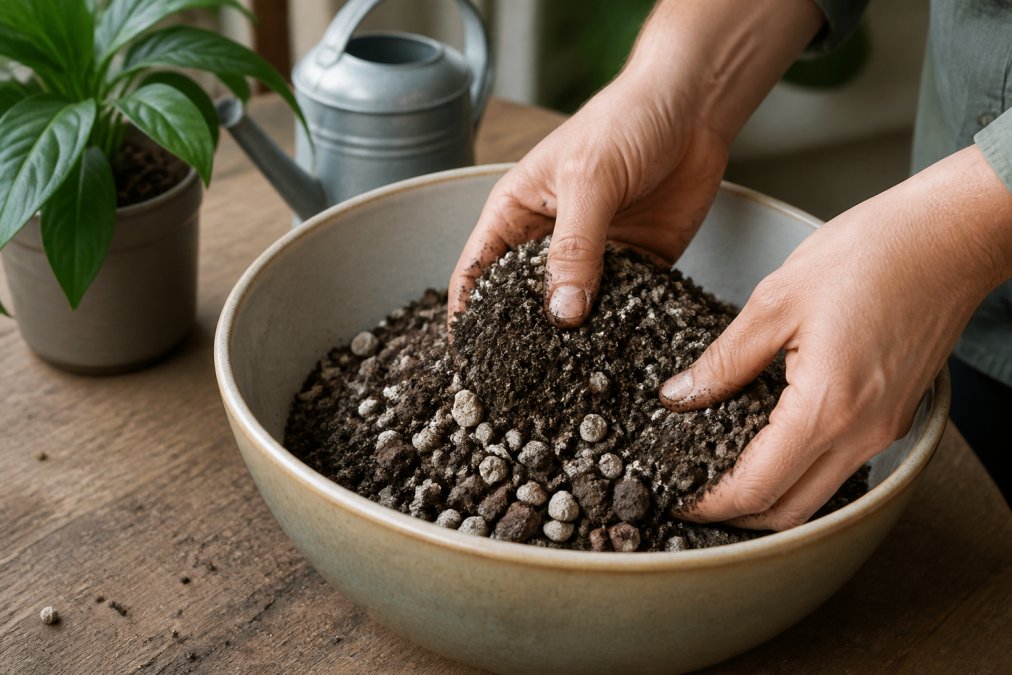
- Succulents and cacti: 30 to 40 percent volcanic mineral by volume. These plants rot faster than almost anything else.
- Tropical houseplants (pothos, monstera, philodendron): 15 to 25 percent. Enough to keep the mix open without drying it out.
- Herbs and vegetables in containers: 10 to 20 percent. They need consistent moisture more than they need aggressive drainage.
- Clay garden soil: 10 to 15 percent by volume worked into the top layer, reapplied annually.
- Hydroponics and semi-hydro setups: mineral media can replace or supplement clay pebbles, since zeolite holds nutrient ions in solution.
Long-Term pH Impact
Zeolite is near-neutral and tends to buffer pH rather than shift it, which is one reason it's favored over other amendments. Over several seasons, cation exchange can gradually raise pH in very acidic mixes as calcium and magnesium accumulate (PubMed). Check pH annually for acid-loving plants like blueberries or gardenias, and adjust with the appropriate amendment rather than guessing.
Visual Identification: High-Quality vs Low-Quality Volcanic Additives
You can spot a poor-quality product before opening the bag. High-quality zeolite is uniform in color, gray-green to off-white, with visible internal structure when broken and a dense, slightly rough feel.
Low-quality product shows the opposite: excessive dust, inconsistent particle size, and a chalky texture. Some cheap amendments are diluted with filler that adds weight but no porosity. If the bag feels unusually heavy for its volume and the contents crumble to powder in your hand, the porosity you paid for may not be there.
Troubleshooting: When Volcanic Minerals Fail
Minerals are not a fix for every problem, and it's worth knowing when they won't help.
- The pot has no drainage hole. No amendment compensates for a sealed container. Water has nowhere to go.
- You're overwatering on a fixed schedule. Minerals slow the damage but don't prevent it. Adjust your watering frequency after amending.
- The plant is already rotting. Minerals prevent rot; they don't cure it. Remove affected roots, repot in fresh medium, and start the mineral mix from scratch.
- The mix is too fine overall. If your base medium is mostly peat or fine compost, adding 10 percent mineral won't be enough. Increase the proportion or change the base.
- You're expecting overnight results. Structure improves over weeks as the medium settles and roots colonize the new pore space.
That last point matters most: root rot prevention is a structural strategy, not a treatment, and structure takes time to establish.
Arden Line's Zeolite Mineral Lava Rocks (Granular) run 1.4 to 4 mm, which is fine enough to blend through a potting mix evenly rather than settling into pockets. Both sizes are 100 percent natural clinoptilolite, chemical-free, and OMRI Listed for organic production.

Frequently Asked Questions
How do volcanic minerals improve soil drainage and prevent root rot?
Volcanic minerals like zeolite and volcanic tuff have a porous, honeycomb structure that creates air pockets in potting mix or garden soil. This improves drainage, stops waterlogging, and keeps oxygen moving around roots. Better root-zone structure means less chance of the soggy conditions that root rot pathogens need. Mixing 10-20% volcanic minerals into your soil is usually enough to see a difference.
Can volcanic zeolite prevent root rot in potted plants?
Yes, when used correctly. Zeolite absorbs excess moisture and releases it slowly, which prevents the waterlogged conditions that cause root rot. It also holds nutrients like potassium and ammonium in its structure, so they don't leach away. For potted plants, mix zeolite at about 15% of the total volume. It works best alongside a well-draining potting medium, not as a replacement for one.
What are the signs of root rot in houseplants, and when should I add volcanic minerals?
Look for yellowing leaves, mushy brown roots, a sour smell from the soil, and stunted growth. If you catch it early, repot the plant into fresh mix amended with volcanic minerals. Trim any black or soft roots first. Adding minerals at repotting time improves drainage and aeration going forward, which lowers the odds of the problem returning.
How does zeolite compare to perlite for plant roots?
Perlite is lightweight and creates air space, but it doesn't hold nutrients or moisture. Zeolite is heavier, holds water and nutrients in its pores, and has a higher cation exchange capacity. Perlite is cheaper and good for seed starting. Zeolite lasts longer in the soil and does more for nutrient retention. Many growers use both, with zeolite at 10-15% and perlite at 10-20% of the mix.
Root rot is preventable, but only if you treat the root zone as a structural system rather than a watering problem. Arden Line makes that straightforward with pure volcanic zeolite that improves drainage, aeration, and nutrient retention in containers and clay beds alike, without chemicals or fragrances. Every bag is family-made in the USA and packaged in plastic-free kraft. Add a mineral amendment to your next repotting session and give your roots the pore space they've been missing.

Leave a comment
This site is protected by hCaptcha and the hCaptcha Privacy Policy and Terms of Service apply.