

Table of Contents
- Step 1: Test Your Soil Before You Amend It
- Step 2: Build Organic Matter With Compost and Well-Rotted Manure
- Step 3: How to Improve Drainage in Clay Garden Soil
- Step 4: The Benefits of Zeolite for Soil Health
- Step 5: How to Prevent Nutrient Leaching in Garden Soil
- Step 6: Mulch, Cover Crops, and Reduced Tillage
- Step 7: When to Adjust Soil pH and Add Biochar
- Conclusion
- Frequently Asked Questions
Last Updated: September 11, 2026
Step 1: Test Your Soil Before You Amend It
Improving soil nutrient retention naturally starts with a soil test, not a shopping trip. A laboratory analysis tells you exactly what your soil holds, what it loses, and what it needs, which stops you from amending blind.
Soil nutrient retention is the ability of soil to hold plant-available nutrients in the root zone instead of letting them wash or volatilize away. That capacity depends on organic matter, clay and humus content, pH, and biological activity.
Most gardeners skip testing and guess. That is a mistake. A standard test from a cooperative extension lab reports pH, organic matter, phosphorus, potassium, calcium, and magnesium, and many labs add cation exchange capacity (CEC), the measure of how many positively charged nutrient ions your soil can hold (extension.psu.edu).
Test every two to three years, in the same season each time. Sampling depth should be 6 to 8 inches for garden beds.
| What to Test | Why It Matters for Retention | How Often |
|---|---|---|
| pH | Controls nutrient availability | Every 2-3 years |
| Organic matter | Fuels CEC and aggregation | Every 2-3 years |
| CEC | Measures nutrient-holding capacity | Every 2-3 years |
| Phosphorus and potassium | Reveals existing reserves | Every 2-3 years |
The USDA Natural Resources Conservation Service soil health guidance covers sampling methods and what each lab value means.
Step 2: Build Organic Matter With Compost and Well-Rotted Manure
Compost and well-rotted manure raise organic matter, and organic matter is the engine behind nutrient retention. Humus, the stable end product of decomposition, carries a high CEC and holds both water and dissolved nutrients against leaching.
Apply 2 to 4 inches of finished compost to garden beds and work it into the top 6 inches. For manure, use only well-rotted material, never fresh. Fresh manure burns roots with excess salts and carries pathogens.
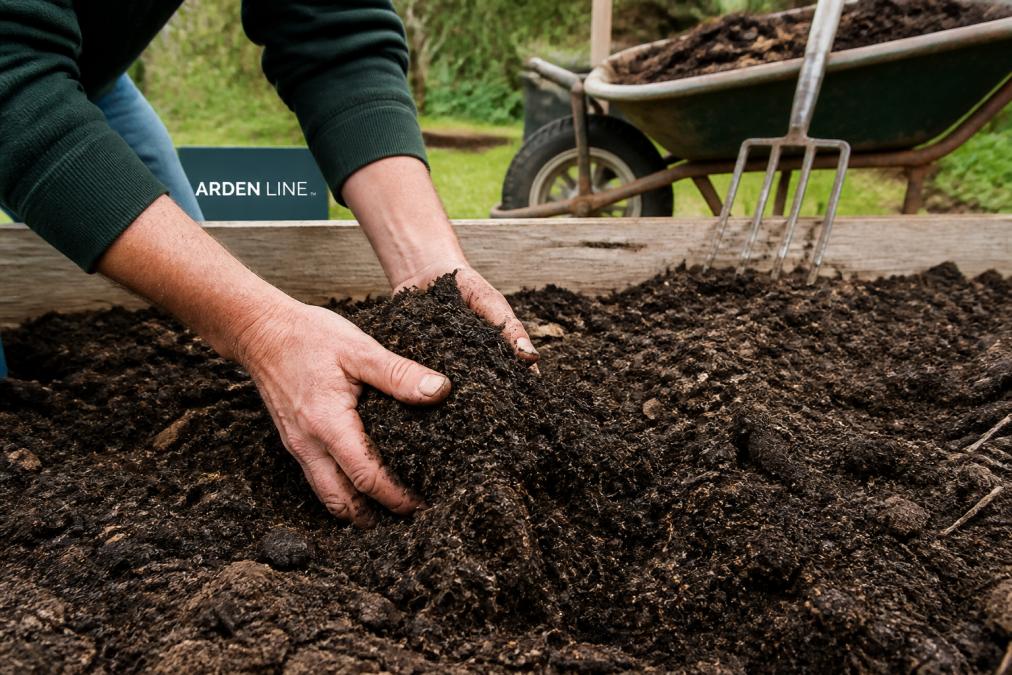
A common mistake is treating compost as a one-time fix. Organic matter mineralizes and disappears over time, so annual topdressing keeps the level stable. Many growers find that a light application every season outperforms a heavy application once.
Step 3: How to Improve Drainage in Clay Garden Soil
Improving drainage in clay garden soil means fixing structure, not just adding water. Clay particles are tiny and tightly packed, so water and air move slowly through them, roots suffocate, and nutrients sit locked or leach sideways.
The problem is rarely too much clay. It is compaction and poor aggregation. Compaction squeezes out the micropores that hold plant-available water and the macropores that drain excess.
What works:
- Add organic matter annually to feed aggregation
- Avoid working clay soil when it is wet
- Keep off beds to prevent compaction
- Topdress rather than deep-till
Gypsum helps some sodic clay soils but does little for ordinary clay. Test first. If your drainage problem is compaction, adding water-holding amendments makes it worse, not better.
Step 4: The Benefits of Zeolite for Soil Health
Zeolite earns its place in a nutrient-retention plan because of one property most amendments lack: a rigid, negatively charged crystalline lattice with internal cages. That structure gives zeolite a very high cation exchange capacity (CEC) for a mineral, often in the range of 100 to 200 cmol/kg, far above typical soil clay, so positively charged nutrients like ammonium, potassium, calcium, and magnesium are held on the lattice instead of leaching past the root zone.

The mechanism matters more than the marketing. When you irrigate or rain falls, soluble nitrate and potassium normally travel downward with the wetting front. In sandy soil, that front moves fast and the root zone drains before plants can take up what you applied. Zeolite slows that loss in two ways: its cages physically trap ammonium and small molecules, and its negative surface charge electrostatically holds cations until roots exchange for them. Release is gradual, driven by plant demand and moisture, not by a single flush.
Where zeolite helps most:
- Sandy soil: raises CEC and water-holding capacity in a medium that otherwise has almost none.
- Container and raised-bed mixes: reduces the frequency of nutrient leaching from repeated watering.
- High-traffic beds: buffers against the nutrient loss that comes with frequent irrigation.
- Ammonia control: traps ammonium, which reduces volatilization loss in beds amended with manure or urea.
Where it does not help:
- Ordinary clay soil: clay already has high CEC, so zeolite adds little to nutrient holding. Its aeration benefit is modest and not a substitute for fixing compaction.
- Sodic clay: gypsum is the correct amendment; zeolite is not.
- Acidic or alkaline extremes: zeolite does not adjust pH, and pH still governs whether held nutrients are plant-available.
Application rates vary by product and soil test, so follow the label rather than a blanket rule. A common pattern is blending a granular grade into the top 4 to 6 inches at seeding or bed preparation, then topdressing finer grades in containers. Because zeolite is a mineral and does not mineralize like compost, a single application persists for years, which is both its advantage and its caution. Over-application in already high-CEC soil buys nothing.
Step 5: How to Prevent Nutrient Leaching in Garden Soil
To prevent nutrient leaching in garden soil, you have to slow water down and give nutrients something to cling to. Leaching happens when soluble nutrients, especially nitrate and potassium, dissolve and move below the root zone with irrigation or rain.
Four practical defenses:
- Split fertilizer applications instead of one heavy dose
- Irrigate deeply but less often to limit runoff
- Keep soil covered so rain does not pound bare ground
- Raise CEC with organic matter and mineral amendments
Nutrient runoff also carries phosphorus into waterways, which is why EPA guidance on nutrient pollution treats lawn and garden runoff as a real water-quality issue.
A common mistake is watering a little every day. Shallow, frequent watering keeps roots near the surface and pushes soluble nitrogen down and away. Deep, infrequent watering does the opposite.
Step 6: Mulch, Cover Crops, and Reduced Tillage
Mulch, cover crops, and reduced tillage protect the soil surface and the biology beneath it, but the reason they improve nutrient retention is more specific than "they're good for soil." Each one interrupts a different loss pathway.
Mulch cuts evaporation and buffers raindrop impact. Bare soil takes the full energy of a storm, which breaks aggregates apart, seals the surface, and sends soluble nutrients running off instead of infiltrating. A 2- to 3-inch layer of straw, shredded leaves, or wood chips keeps the surface open, moderates temperature swings that drive organic matter mineralization, and feeds the fungal-dominated food web at the soil surface. Keep mulch a few inches off stems to avoid rot and rodent pressure.
Cover crops scavenge nutrients that would otherwise leach. Cereal rye, crimson clover, hairy vetch, and tillage radish each play a different role: rye and radish take up residual nitrogen and hold it in living tissue over winter, while legumes fix new nitrogen that becomes available when terminated. Terminate by crimping, mowing, or winter-kill rather than tilling under where you can, the residue becomes surface mulch and the roots become channels for water and air.
Reduced tillage is where the biological retention story gets interesting, and it's the part most guides skip. Tillage doesn't just disturb structure; it shreds the arbuscular mycorrhizal fungal networks that extend far beyond the root. Those hyphae act as an extension of the root system, exploring soil the plant cannot reach and trading water and phosphorus back to the host in exchange for sugars. A well-colonized root system effectively widens the nutrient-foraging zone by orders of magnitude, which is why undisturbed soils often hold and deliver phosphorus better than tilled ones at the same soil test level.
That fungal network is also part of what builds stable aggregates. Glomalin, a glycoprotein produced by mycorrhizal fungi, acts as a biological glue that binds soil particles into water-stable aggregates. Those aggregates create the pore structure that holds both water and dissolved nutrients against gravity and leaching. Tillage destroys the hyphae, the glomalin, and the aggregates in a single pass, which is the real argument for leaving the soil alone.
A practical sequence:
- Keep the surface covered year-round with mulch or living cover.
- Choose cover crops by the nutrient you're trying to hold, rye and radish for residual nitrogen, legumes for new nitrogen.
- Terminate covers without inverting the soil where possible.
- Limit tillage to the minimum needed to establish crops, and avoid working soil when it's wet.
Step 7: When to Adjust Soil pH and Add Biochar
Adjust pH first, then consider biochar, because pH controls how available your nutrients already are. Most vegetables and ornamentals grow best between pH 6.0 and 7.0. Outside that range, nutrients may be present but chemically locked and unavailable to roots.
Lime raises pH on acidic soil. Elemental sulfur lowers it on alkaline soil. Apply based on your test recommendation, not a guess, and retest before adjusting again.
Biochar is a long-term play. This charred organic material is highly porous and persists in soil for years, adding CEC and habitat for microbial activity. Charge it first by mixing with compost or a liquid fertilizer, because raw biochar can initially tie up nutrients rather than hold them.
Conclusion
Getting soil to hold nutrients is a slow build, not a single purchase. Test, feed organic matter, fix structure, and protect the surface, and retention improves season over season.
For the mineral piece of that plan, Arden Line offers a natural, chemical-free option. Our Zeolite Mineral Lava Rocks improve drainage, aeration, and nutrient retention, trap moisture and ammonia, and come OMRI Listed in plastic-free packaging, family-made in the USA. Add to cart and give your soil the mineral backbone it has been missing.

Frequently Asked Questions
How do you add nutrients back into soil naturally?
Start with a soil test to see what is actually missing, then work in 2 to 4 inches of finished compost or well-rotted manure each season. Add a mineral amendment such as zeolite to hold onto the nutrients you apply, and keep the surface covered with mulch or a cover crop so rain does not wash them away. Rotate what you plant and let roots and worms do the mixing instead of tilling.
How does zeolite help in maintaining soil nutrient levels?
Zeolite is a volcanic mineral with a honeycomb structure that holds positively charged nutrients like ammonium, potassium, calcium, and magnesium on its surface instead of letting them leach past the root zone. Arden Line's zeolite is OMRI Listed for organic production.
Can natural minerals improve soil health without synthetic fertilizers?
Yes. Minerals like zeolite, biochar, and rock dust do not feed plants directly. They change the soil so it holds water and nutrients better, which makes compost and cover crops go further. On their own they will not fix a severe nitrogen shortage, but paired with organic matter they reduce how much fertilizer you need and how often you apply it.
What is the best natural soil amendment for nutrient retention?
There is no single winner. Compost builds humus and feeds microbial activity, zeolite raises cation exchange capacity and holds ammonium, and biochar adds long-term surface area that lasts for years. Most gardeners get the best results layering all three: compost for biology, zeolite for immediate nutrient holding, and biochar for the long haul. Test your soil first so you are not adding what you already have.

Leave a comment
This site is protected by hCaptcha and the hCaptcha Privacy Policy and Terms of Service apply.