
Table of Contents
- Why Clay Soil Drains Poorly (And What That Means for Your Garden)
- How to Test Soil Drainage in Your Garden
- The Sand Myth and Other Drainage Mistakes to Avoid
- Best Organic Amendments for Clay Soil
- Using Zeolite for Soil Drainage and Nutrient Retention
- When Amendments Aren't Enough: Mechanical Fixes
- Seasonal Timing: When to Amend Clay Soil for Best Results
- Conclusion: Build Long-Term Soil Health
- Frequently Asked Questions
Last Updated: September 5, 2026
Heavy clay soil is one of the most frustrating challenges a gardener can face. If you want to know how to improve drainage in clay garden soil, the answer is not a single quick fix but a layered strategy focused on organic matter and long-term soil structure. This guide from Arden Line walks through tested methods, common mistakes, and the amendments that actually work.
Most drainage problems trace back to the soil's physical makeup. Clay particles are microscopic and pack tightly together, leaving little pore space for air or water to move through. While sandy soil lets water race past roots, clay holds moisture like a sponge, often leading to waterlogging and poor soil aeration. You can correct this over time by changing the soil's aggregate structure rather than fighting its texture.
Why Clay Soil Drains Poorly (And What That Means for Your Garden)
Clay soil drains poorly because its tiny, flat particles bind together so tightly that water has almost nowhere to travel. When rain falls faster than the soil can absorb it, the water pools on the surface or sits in the root zone for days, starving roots of oxygen and creating the perfect conditions for rot and fungal disease.
The structure of clay also explains why it behaves so differently across seasons. In wet weather, it swells into a sticky, plastic mass that is nearly impossible to work. In dry weather, it shrinks and cracks into hard blocks that resist water infiltration entirely. Many gardeners mistake this for a moisture problem when it is actually a compaction problem rooted in the soil texture itself.
Surface-level fixes will keep failing. Simply watering less or adding a little compost on top does not address the dense layer below. Real improvement requires building soil porosity and encouraging soil biology deep in the profile, which is why the amendments and techniques covered below focus on structure rather than quick surface patches.
How to Test Soil Drainage in Your Garden
A simple percolation test tells you whether your drainage problem is severe or manageable. Dig a hole about 30 cm deep and 15 cm wide, fill it with water, and let it drain completely. Fill it a second time and measure how long the water takes to disappear. If the hole drains within four hours, your soil is workable (extension.org). If water still sits after 24 hours, you have a serious drainage issue that will need both amendments and mechanical fixes.
| Drainage Test Result | What It Means | Recommended Action |
|---|---|---|
| Drains in under 4 hours | Good structure, minor issues | Add compost seasonally |
| Drains in 4 to 12 hours | Moderate compaction | Organic amendments plus aeration |
| Water remains after 24 hours | Severe waterlogging | Raised beds or French drains |
Check your soil's texture by rolling a moist handful between your fingers. If it forms a smooth, shiny ribbon that holds together, you are working with heavy clay. If it crumbles easily, you have more loam in the mix. This quick assessment, combined with the drainage test, tells you whether you need to focus on soil conditioning or on redirecting water away from the garden entirely.
The Sand Myth and Other Drainage Mistakes to Avoid
Adding sand to clay soil is the single most common mistake in drainage improvement, and it makes the problem worse. When you mix coarse sand into fine clay, you create something closer to concrete than garden soil (extension.org). The sand fills the pore spaces between clay particles, locking everything together into a dense mass that water cannot penetrate. Unless you are adding sand in proportions of roughly 70 percent sand to 30 percent clay, which is impractical for most gardens, skip it entirely.
The sand myth isn't just about texture, it's about cost. A cubic yard of coarse builder's sand runs $25 to $50, and spreading it across a 100-square-foot bed at the recommended ratio would require about 2.5 cubic yards. That's $125 to $150 for a single bed, plus labor, and you'd still end up with soil that drains worse. Compare that to $40 to $60 for the same volume of bulk compost, which actually improves structure.
Another frequent error is tilling wet clay. Working soil when it is saturated destroys aggregate structure, compressing particles into a hardpan that blocks drainage for years. The same applies to walking on wet beds. A common rule is to wait until a handful of soil crumbles when squeezed rather than forming a sticky ball. Timing matters: clay in the Southeast stays wet well into April, while clay in the Southwest may be workable by late February. Know your regional weather patterns.
Relying solely on gypsum is another misconception worth addressing. Gypsum is a useful soil amendment, but only for clay that is high in sodium, which is rare in most garden settings. For typical clay, gypsum does little to improve drainage, and it will not fix compaction caused by foot traffic or machinery. Understanding what your soil actually needs prevents wasted effort and money.
A quieter mistake is over-amending with organic matter in a single season. Adding more than 7 to 10 cm of compost at once can create a layer that holds water like a sponge, worsening drainage in the short term (gov.uk). The goal is steady, repeated additions over multiple seasons.
Best Organic Amendments for Clay Soil
Organic matter is the foundation of any successful clay soil improvement plan, and it works by binding clay particles into larger aggregates. These aggregates create the pore space that allows water to move through the profile while still retaining moisture for plant roots. Unlike sand, organic amendments work with the soil's biology rather than against it.
Compost and Mulch: The Foundation of Better Soil Structure
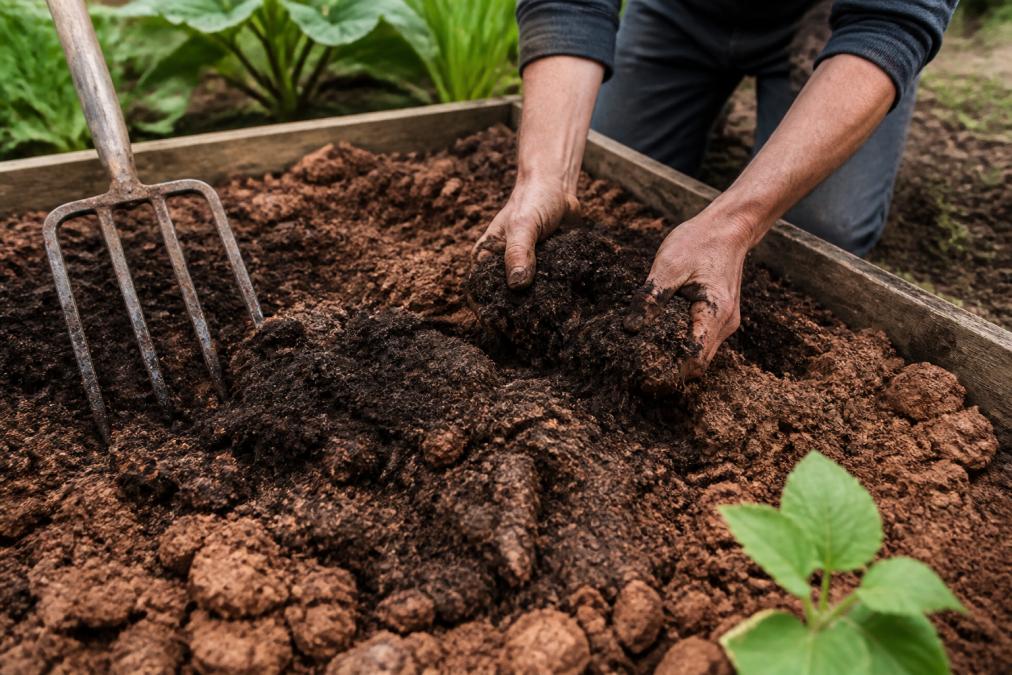
Compost is the most reliable amendment for clay because it feeds the microorganisms that build soil structure. Spread a 7 to 10 cm layer of finished compost over your beds each season and work it into the top 15 cm of soil. The organic matter encourages earthworms and beneficial bacteria, whose activity creates the tunnels and aggregates that improve drainage naturally.
Mulch works alongside compost by protecting the soil surface from rain impact. Heavy raindrops on bare clay cause surface sealing, where the top few millimeters form a crust that blocks water infiltration. A 5 cm layer of wood chips, straw, or shredded leaves absorbs that impact and keeps the soil surface open. Over time, mulch breaks down and adds more organic matter to the profile below.
Gypsum: A Targeted Tool for Sodium-Rich Clay
Gypsum is a calcium-based soil amendment that helps improve drainage in clay soil when the clay is high in sodium. In these sodic soils, sodium causes clay particles to disperse and seal off pore spaces. The calcium in gypsum replaces the sodium, allowing particles to flocculate into larger aggregates that drain more freely.
For the vast majority of home gardens that do not have sodic clay, gypsum offers little measurable benefit. If you suspect sodium is an issue, a soil test will confirm it before you invest in bags of gypsum. Otherwise, your effort is better spent on compost and other organic materials that support long-term soil health.
Using Zeolite for Soil Drainage and Nutrient Retention
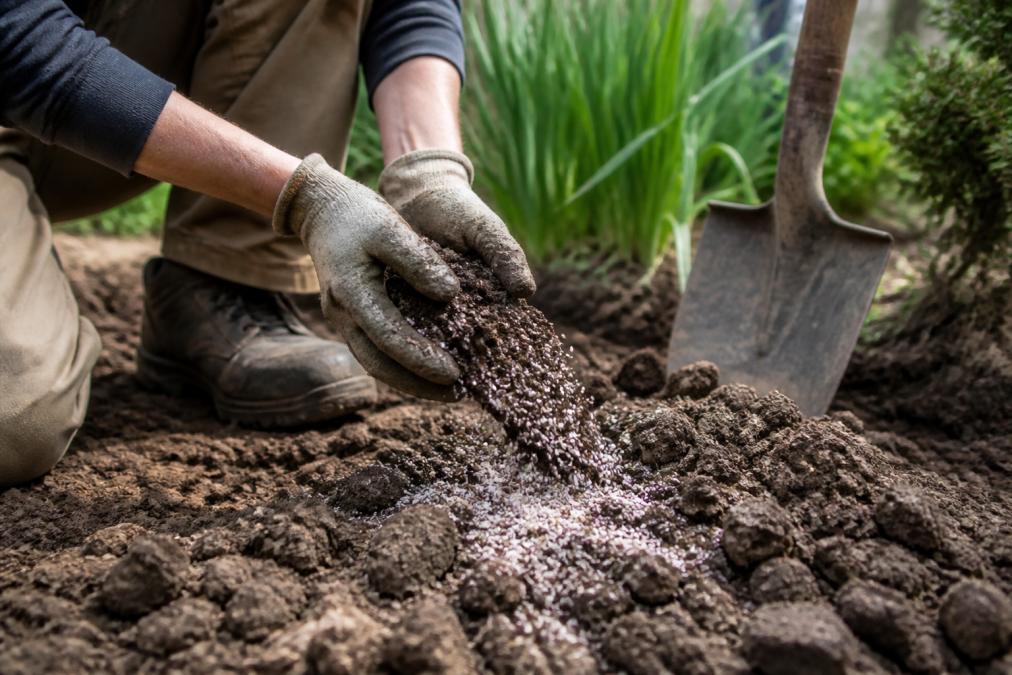
Zeolite is a natural volcanic mineral that improves drainage in clay garden soil while also holding onto nutrients that would otherwise wash away. Unlike organic amendments that decompose and need replacing, zeolite is a permanent physical amendment. Its porous, honeycomb structure creates stable pore space in heavy soil, improving aeration and water movement without breaking down over time.
The same properties that make zeolite valuable in managing moisture and odor in chicken coops translate directly to garden applications. In clay soil, zeolite acts as a reservoir for both water and dissolved nutrients, releasing them slowly to plant roots. This reduces the risk of nutrient leaching during heavy rain while keeping moisture available during dry spells. Products like those from Arden Line, which use 100 percent natural volcanic zeolite, are approved for use in organic production and offer a chemical-free way to condition heavy soil.
One of the advantages zeolite has over compost alone is longevity. Organic matter needs to be replenished as it decomposes, but zeolite remains effective in the soil for years. For gardeners dealing with persistent clay drainage problems, combining zeolite with regular compost applications addresses both the physical structure and the biological activity of the soil.
When Amendments Aren't Enough: Mechanical Fixes
When drainage is so poor that water sits on the surface for days, amendments alone will not solve the problem. In these cases, you need to redirect water away from the garden or lift the planting zone above the saturated soil. These mechanical approaches are more involved but deliver immediate results.
How do you know when you've crossed the line from "needs more compost" to "needs a drain"? The percolation test from earlier is your guide. If water still sits in your test hole after 24 hours, and you've already added organic matter for two or more seasons, mechanical intervention is justified. Another sign is standing water that persists for more than 48 hours after a heavy rain in multiple spots across your yard. That's not a soil amendment problem, that's a water management problem.
Raised Beds and French Drains
Raised beds are the most practical solution for severe clay drainage because they bypass the problem entirely. By building beds above the native soil, you create a controlled growing environment with the soil texture you choose. Fill raised beds with a mix of compost, topsoil, and coarse material to guarantee good drainage from the start. This approach is especially effective for vegetable gardens where consistent moisture is critical.
Depth matters: for most vegetables, you need at least 30 cm of quality soil above the clay, and for deep-rooted crops like tomatoes or carrots, 45 cm is better. A 1.2 m by 2.4 m bed, 30 cm deep, requires roughly 0.9 cubic yards of soil mix. At $40 to $60 per cubic yard, that's $36 to $54 per bed just for fill material, plus the frame. If you're covering a large area, the economics may push you toward a French drain instead.
For gardens where raised beds are not an option, a French drain can redirect subsurface water away from planting areas. A French drain is a trench filled with gravel and a perforated pipe that collects and channels water to a lower point. Installing one along the uphill side of a soggy garden can intercept groundwater before it reaches your plants. This is a larger project, but it permanently solves waterlogging caused by underground springs or heavy runoff.
Here's what a proper French drain installation actually involves:
- Dig a trench 45 to 60 cm deep and 30 cm wide, sloping at least 1 percent (about 1 cm drop per meter) toward your drainage outlet. For a 10-meter run, that's a 10 cm drop from start to finish.
- Line the trench with landscape fabric to prevent soil from clogging the gravel over time.
- Add 5 to 7 cm of washed gravel at the bottom, then lay a 10 cm perforated PVC pipe with the holes facing down.
- Cover the pipe with another 15 to 20 cm of gravel, then fold the landscape fabric over the top.
- Backfill with the excavated soil or a layer of topsoil, leaving a slight depression to direct surface water into the trench.
A simpler alternative for smaller problem areas is a dry well. Dig a hole 60 to 90 cm deep, fill it with gravel, and cover it with soil. Water collects in the gravel and slowly percolates into the surrounding soil. This works well for a single low spot but won't solve widespread waterlogging.
If your drainage problem comes from a patio, walkway, or driveway that sheds water onto your garden, replacing solid paving with permeable pavers or gravel can reduce runoff dramatically. A 20-square-meter patio made of permeable pavers can absorb most of the rain that falls on it. This is a bigger investment, but it addresses the source of the problem.
Whichever mechanical fix you choose, remember that it works alongside your organic matter program, not instead of it. The drain stops the flooding; the compost builds the soil structure that lets roots thrive once the water is gone.
Seasonal Timing: When to Amend Clay Soil for Best Results
Fall is the best time to amend clay soil because it gives amendments months to work before spring planting. When you add compost and other organic matter in autumn, winter freeze-thaw cycles help break up compacted clay while soil organisms process the material. By spring, the soil structure has improved enough to support healthy root growth.
Spring amendments are possible but less effective if the soil is still wet from winter rains. Working clay when it is too moist causes compaction. If you must amend in spring, wait until the soil is dry enough to crumble in your hand, and apply amendments as a top dressing rather than tilling.
The long-term goal is to build soil health so that drainage improves with each passing season. Regular additions of organic matter, combined with zeolite for stable structure, gradually transform heavy clay into workable soil. This is not a one-time project but an ongoing relationship with your garden's soil biology.
Conclusion: Build Long-Term Soil Health
Improving drainage in clay garden soil is not about a single dramatic fix but about consistent, layered effort. Start by testing your drainage, skip the sand, and build your soil with compost, mulch, and zeolite. Where water is extreme, raised beds or French drains provide immediate relief while your long-term soil conditioning takes effect. Natural mineral amendments can transform heavy clay into productive garden beds, supporting healthier roots and better yields without chemicals. Get started with Arden Line zeolite and give your clay soil the structure it needs to drain, breathe, and grow.
Frequently Asked Questions
Does adding sand to clay soil help drainage?
No. Adding sand to clay soil is one of the most common and damaging mistakes. Sand particles are large, while clay particles are microscopic. When mixed, the sand doesn't create pore space; it forms a concrete-like substance that makes drainage worse and is nearly impossible to reverse. Instead of sand, focus on adding organic matter like compost, which binds clay particles into larger aggregates and creates the pore space water needs to move through.
How deep should I amend clay soil for better drainage?
For most garden beds, amend the top 6 to 8 inches of soil. This is the primary root zone for vegetables, annuals, and most perennials. Work in 2 to 3 inches of compost or another organic amendment across the entire bed surface, not just in planting holes. Amending only the planting hole creates a 'bathtub' effect where water collects and drowns the roots. For trees and shrubs, amend a wider area, roughly 3 times the width of the root ball.
What is the best organic amendment for clay soil?
Compost is the most reliable and effective organic amendment for clay soil. It introduces organic matter that feeds soil biology, which in turn creates the aggregate structure needed for drainage. Well-rotted leaf mold, aged manure, and worm castings are also excellent options. For a mineral-based addition, zeolite can improve drainage and aeration while also retaining nutrients and moisture for plant roots. Avoid peat moss, which can repel water when dry and is not a sustainable choice.
How long does it take to improve drainage in clay soil?
You will see noticeable improvement within one growing season after a substantial application of compost, but truly fixing clay soil is a long-term project. Soil biology needs time to work organic matter into the structure. Expect significant progress over 2 to 3 years of annual amendments. For severe compaction or persistent waterlogging, mechanical solutions like a French drain or raised beds provide immediate results while your long-term soil improvement efforts take hold.

Leave a comment
This site is protected by hCaptcha and the hCaptcha Privacy Policy and Terms of Service apply.