
Table of Contents
- What Zeolite Is and Why Chicken Keepers Use It
- Zeolite for Chicken Coop Bedding: Safety and Application
- Zeolite to Control Ammonia in Poultry Houses
- Zeolite for Poultry Feed: Benefits and Precautions
- Is Zeolite Dust Harmful to Chickens? What the Evidence Shows
- Practical Dosage, Product Quality, and Safe Handling
- When to Avoid Zeolite and What to Do if Concerns Arise
- Frequently Asked Questions
Last Updated: October 14, 2026
What Zeolite Is and Why Chicken Keepers Use It
Mineral zeolite is a naturally porous volcanic rock that traps moisture, ammonia, and odors at the molecular level through physical absorption rather than chemical treatment, and the answer to whether is mineral zeolite safe for chickens depends on how you use it, which this guide covers in detail.
Its porous structure gives it enormous surface area, absorbing liquids and gases without releasing them, capturing ammonia and pulling moisture from damp bedding.
Zeolite fits that need and is approved for organic production.
It comes in different forms: coarser particles for bedding and coop floors, finer dust for dust baths, and small amounts added to poultry feed by some producers.

Zeolite for Chicken Coop Bedding: Safety and Application
The short answer to whether is mineral zeolite safe for chickens in bedding is yes, it poses no toxicity risk when applied correctly at reasonable rates.
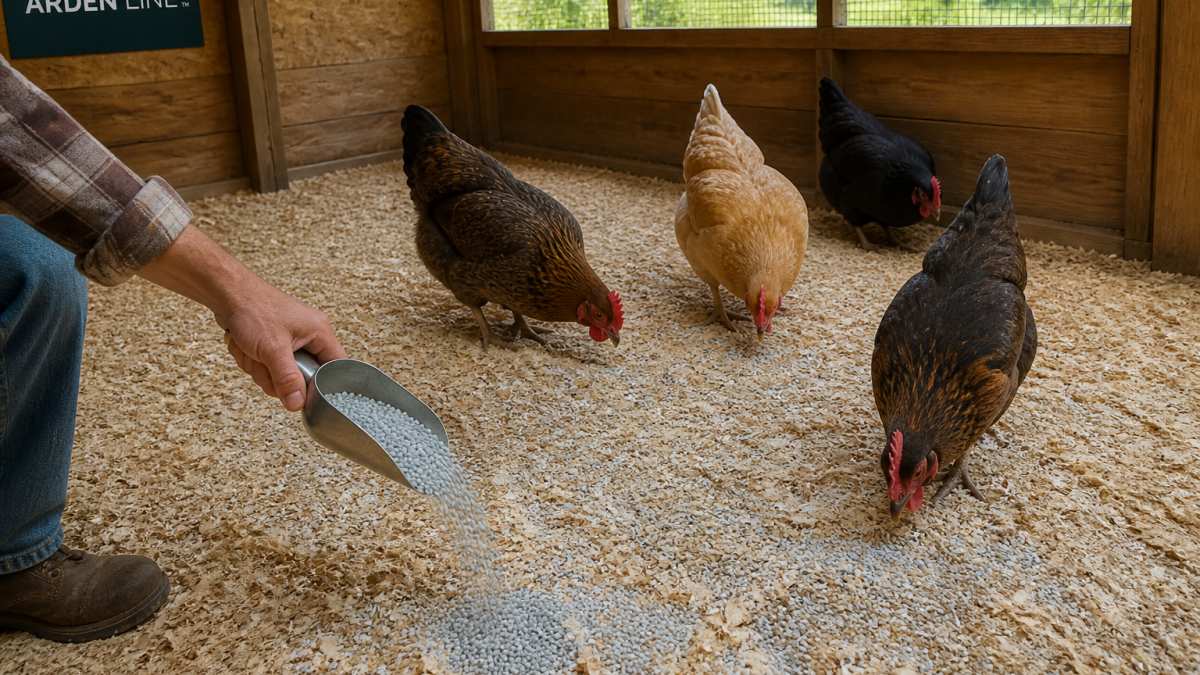
The key is particle size. Coarse zeolite (sand-like texture) works well for bedding without creating inhalable dust; reserve fine powder for dust baths.
Here's how to apply it:
- Sprinkle zeolite directly on coop floors before adding bedding
- Mix it into the top layer of wood shavings or straw
- Add a light layer to nesting boxes
- Reapply after each cleaning or when bedding becomes damp
One application typically lasts 2-4 weeks depending on flock size and weather. Start light and adjust based on odor and moisture.
The Arden Line Chicken Coop Deodorizer is 100% natural zeolite with no additives. It is available in 12 lb and 24 lb sizes.

Zeolite to Control Ammonia in Poultry Houses
Ammonia is the main problem zeolite solves in poultry housing. Chicken manure releases ammonia gas as it breaks down. In enclosed spaces, ammonia builds up quickly and irritates the respiratory system of birds, and people cleaning the coop.
Zeolite binds ammonia molecules instead of letting them escape into the air. This is adsorption, not absorption: the ammonia sticks to the mineral's surface until the zeolite is removed.
The result is better air quality that supports respiratory health.
Zeolite for Poultry Feed: Benefits and Precautions
Feed is the one zeolite use case where the safety question is genuinely open. Eating it, walking on it, and bathing in it carry different risks, and feed is the only route where the mineral enters the bird's digestive tract on purpose.
What feed-grade zeolite actually is. The zeolite used in poultry diets is almost always clinoptilolite, the same mineral used in litter but sold under a different specification. Feed-grade material is milled to a defined particle size, screened for heavy metals and dioxins, and labeled with its mineral content.
Why it is added at all. Zeolite is a hydrated aluminosilicate with a cage-like crystal structure carrying a net negative charge, which attracts positively charged ions including ammonium and holds them in the pores. In the gut, this binding may slow ammonia release from protein breakdown and improve nitrogen use.
The laying-hen question, stated plainly. Keepers worry that a mineral with strong cation-exchange capacity could bind calcium in the gut and reduce what a hen absorbs for eggshell formation.
If you still want to feed it.
- Use only product labeled feed-grade, with stated clinoptilolite content and a contaminant test on file. Ask the supplier for the certificate of analysis.
- Start low: roughly 1 to 2 tablespoons per 5 pounds of feed, mixed thoroughly so no bird gets a concentrated mouthful.
- Keep particle size coarse enough that it doesn't billow when poured. Fine powder in a feeder is an inhalation problem.
- Give it four to six weeks, then evaluate shell quality and feed intake. If either slips, pull it and see whether things return to baseline.
- Don't stack it with other mineral binders or clay-based gut products without veterinary input.
When to skip feed use entirely. Skip it if you're fighting a diagnosed mineral deficiency, if hens are in peak lay and you can't afford an unexplained dip, or if you can't confirm the product grade. Litter and dust-bath use deliver most of what backyard keepers want, odor control and dry bedding, without putting the mineral in the bird.
Is Zeolite Dust Harmful to Chickens? What the Evidence Shows
Most articles answer the dust question with a sentence and move on. Here is the mechanism, the numbers that matter, and the precautions that reduce exposure.
Why particle size is the whole story. The hazard from any mineral dust depends on whether particles are small enough to pass the upper airway and reach the gas-exchange region of the lung.
That's why the same mineral can be low-risk in one form and a genuine concern in another. Coarse clinoptilolite granules shed almost no respirable dust when spread; finely milled powder can produce a visible cloud, and a visible cloud always contains a respirable fraction. The mineral isn't the variable, the milling is.
What the poultry evidence actually supports. Chickens have air sacs extending into their bones and are more sensitive than mammals to airborne irritants, well established for ammonia and fine particulate matter. For zeolite specifically, published respiratory research is limited and mostly involves high-dose, fine-particle exposure in controlled settings rather than normal coop use.
Dust baths are a special case, and mostly a favorable one. A hen dust-bathing deliberately coats her feathers and skin with fine material, a behavioral need, not an accident, and the exposure is self-limited to a few minutes, a different risk profile from a feeder full of powder.
Practical precautions that measurably cut exposure.
- Choose coarse grades for floors, bedding, and nesting boxes. Reserve fine grades for dust baths only.
- Apply outdoors or in a well-ventilated space, and pour low and slow rather than dumping from height. Height is what aerosolizes.
- Never use a leaf blower, shop vac in blow mode, or fan to spread zeolite. That converts a coarse product into an airborne one.
- Let dust settle before returning birds to the area. Fifteen to thirty minutes is a reasonable rule of thumb after any application.
- Wear an N95 or equivalent respirator when handling fine grades, and keep the bag sealed between uses. Keeper exposure is real and easy to overlook.
- Store in a dry place. Damp zeolite clumps, and clumps crumble into fines when you break them up.
Signs that warrant a closer look. Occasional sneezing after a dusty application isn't alarming. Persistent signs are: open-mouth breathing at rest, rattling or gurgling, swollen or foamy eyes, dropped feed intake, or a hen separating from the flock.
Practical Dosage, Product Quality, and Safe Handling
Getting the dosage right matters: too little won't control odor, too much creates dust and waste.
For bedding in a small coop, start with coarse zeolite spread on the floor before adding wood shavings or straw. Reapply when moisture or smell returns.
For nesting boxes, refresh as needed or after heavy use.
For dust baths, provide fine zeolite in a dedicated container or shallow bin. Refresh it as needed.
Product quality is critical. Look for:
- 100% natural volcanic zeolite (clinoptilolite is the preferred mineral)
- No additives, fillers, or chemical treatments
- Testing for contaminants like heavy metals
- Appropriate particle size for your intended use
- Clear labeling of grade (coarse vs. fine)
Arden Line's products meet these standards: sourced and packaged in the USA, tested for purity, and certified OMRI Listed for organic production.
When handling zeolite:
- Store dry to preserve adsorption capacity
- Apply in calm conditions to minimize dust
- Wear a dust mask with fine zeolite
- Don't mix with wet bedding or manure
When to Avoid Zeolite and What to Do if Concerns Arise
Zeolite isn't right for every situation. Understanding when to skip it helps you make better decisions for your flock.
Avoid zeolite if your coop has serious ventilation problems. It manages moisture and odor but can't fix poor air circulation, a damp, poorly ventilated coop needs structural improvements first. Zeolite supplements good management, it doesn't replace it.
Don't use zeolite with chicks under 2-3 weeks old, even coarse particles can be a choking hazard. Wait until they've feathered out and are stronger before introducing dust baths.
If you're concerned after starting, stop and observe: remove the zeolite from coop and bedding and monitor behavior, appetite, and respiratory signs. Most concerns resolve quickly once it's removed.
If respiratory issues persist after removing zeolite, consult a veterinarian. Respiratory disease has many causes, and zeolite is only one possible factor, not the most common one.
For laying hens, if eggshell quality or production changes after adding zeolite to feed, reduce the amount or stop. Every flock is different, and some birds are more sensitive than others.
The bottom line: zeolite is a safe, natural tool when used correctly, but it's not a cure-all. Good coop management, ventilation, regular cleaning, and attention to your birds matter far more than any single product.
Keeping your backyard flock healthy comes down to managing the basics well. Our Chicken Coop Deodorizer and Chicken Dust Bath are 100% natural volcanic zeolite, OMRI Listed, and made right here in the USA. Start with the deodorizer for your coop floors and nesting boxes, add a dust bath for your flock, and you'll notice fresher air and healthier birds. Add to cart and experience the difference clean, natural coop management makes.
Frequently Asked Questions
Is zeolite safe for chickens to ingest?
Yes, food-grade zeolite (clinoptilolite) is safe for chickens when used as a coop amendment. Chickens naturally ingest small amounts while foraging in treated bedding. The mineral passes through their digestive system without being absorbed. However, excessive intake or prolonged exposure to very fine dust can cause respiratory irritation, so proper particle size and ventilation matter. Always use zeolite specifically sourced for animal use, not industrial-grade material.
How much zeolite should I add to my chicken coop?
For coop bedding, sprinkle and reapply as needed or after bedding changes. Smaller backyard setups usually need an appropriate amount per application cycle.
Does zeolite reduce ammonia and odor in a chicken coop?
Yes. Zeolite is a naturally porous mineral that adsorbs ammonia gas and excess moisture, the two main causes of coop smell, rather than masking odors with fragrance. By trapping these compounds in its pore structure, it keeps bedding drier and air fresher between cleanings. This also reduces respiratory irritation for your flock. Results are most noticeable in enclosed or poorly ventilated spaces and when zeolite is applied consistently.
What's the difference between zeolite for coop bedding and zeolite for feed?
Coop bedding zeolite (coarser particles) is designed for litter management and dust bathing, where larger grain size reduces inhalation risk. Both should be food-grade or animal-safe clinoptilolite, but particle size and purity standards differ. Never use industrial or garden-grade zeolite for either application, as contaminants or excessive dust can harm your flock.



Leave a comment
This site is protected by hCaptcha and the hCaptcha Privacy Policy and Terms of Service apply.