
Table of Contents
- Why Heavy Clay Soil Is Difficult to Work With
- How to Loosen Clay Soil: Adding Organic Matter
- Best Amendments for Clay Soil and How to Apply Them
- Raised Beds and No-Dig Methods
- Avoiding Compaction and Soil Damage
- Plants That Grow in Clay Soil
- How Long Does It Take to Improve Clay Soil
- Frequently Asked Questions
Last Updated: October 15, 2026
Why Heavy Clay Soil Is Difficult to Work With
To improve heavy clay soil, you must address how its particles pack tightly, leaving little room for air or water movement and making it hard to dig, plant, and maintain healthy roots.
Wet clay is slippery and compacts easily; dry clay hardens into brick-like clumps. Roots can't penetrate it, and water pools or drains too slowly, causing waterlogging.
The good news: with the right amendments and techniques, clay soil can become workable, fertile ground.
How to Loosen Clay Soil: Adding Organic Matter
The most effective way to improve heavy clay soil is adding organic matter, which breaks up dense clay particles and creates space for air, water, and roots.
Organic matter buffers clay particles, improving structure and drainage while adding nutrients. Apply it consistently over time.
Compost and Well-Rotted Manure
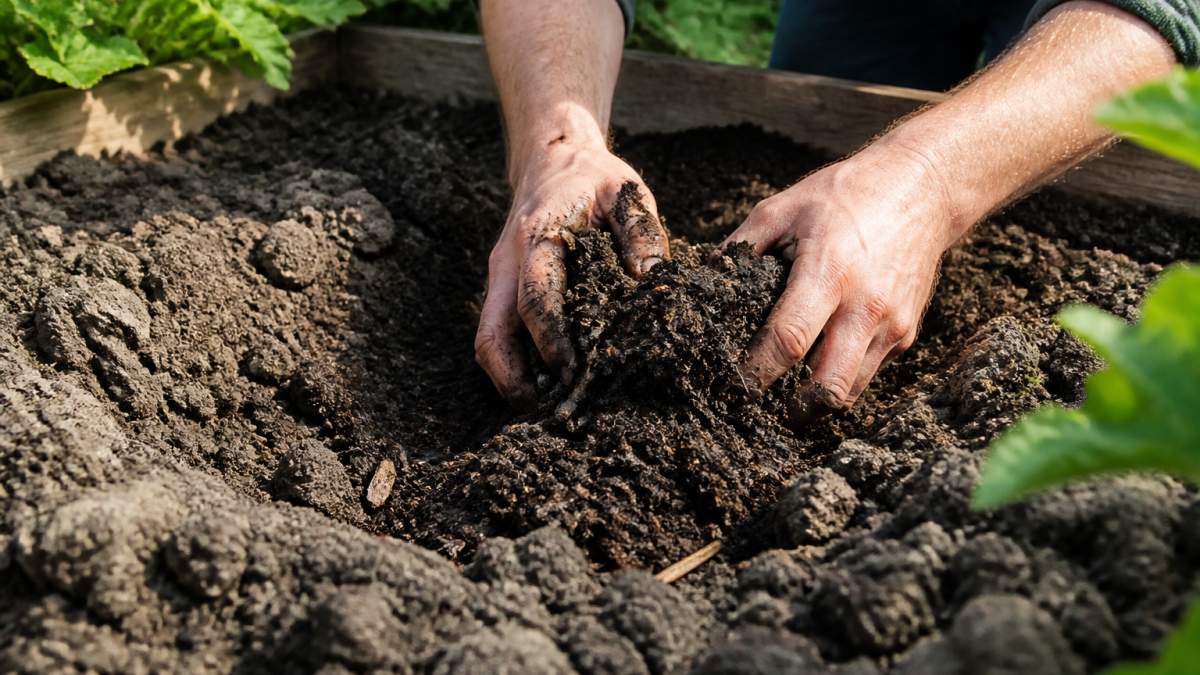
Compost is your best starting point for heavy clay soil improvement, breaking down clay structure while adding beneficial microorganisms.
Apply 2-3 inches of finished compost to clay beds and work it into the top 6-8 inches, mimicking how decomposing material enriches healthy forest floors.
Well-rotted manure works similarly but adds more nutrients. Use only fully composted manure, fresh manure burns plants and introduces weed seeds.
Leaf Mold, Leaves, and Bark
Shredded leaves are free and abundant: collect fallen leaves in autumn, shred them with a mower, and work them into clay beds.
Leaf mold, partially decomposed composted leaves, is even better, blending smoothly into clay without shocking plant roots.
Bark and wood chips add structure but break down slowly. Use them as mulch on top of clay beds rather than mixing them in; they suppress weeds while slowly improving soil beneath.
Mineral Amendments for Drainage
Mineral amendments like zeolite improve drainage without adding organic matter. This naturally porous mineral holds water and nutrients while letting excess moisture drain away.
Unlike compost, zeolite doesn't decompose, it stays stable long-term, providing consistent drainage by creating microscopic air pockets clay particles can't collapse.
Zeolite works best combined with organic matter: the organic material provides immediate structure and nutrients, while zeolite delivers lasting drainage, addressing both short-term workability and long-term water management.
Best Amendments for Clay Soil and How to Apply Them
The best approach combines amendment types: start with organic matter for immediate improvement, then add mineral amendments for lasting drainage.
Amendment Quantities and Application Methods
How much to apply depends on your soil's condition and what you're growing.
For general garden beds:
- Add 2-3 inches of compost annually
- Mix in shredded leaves at a 1:2 ratio (one part leaves to two parts clay)
- Incorporate zeolite at 10-20% by volume for serious drainage problems
For raised beds and new plantings:
- Use a 50/50 blend of compost and native clay soil
- Add 1-2 inches of zeolite to the bottom layer for drainage
- Top with finished compost for planting
For established lawns:
- Top-dress with 1/4 inch of compost each fall
- Aerate first to break up compacted clay
- Avoid disturbing established grass roots
Work amendments in during spring or fall when soil moisture is moderate, wet clay is too sticky, dry clay too hard.
Seasonal Improvement Plan
A practical timeline keeps you consistent:
Fall (September-November):
- Collect and shred fallen leaves
- Work leaves and compost into beds before winter
- Top-dress established lawns with compost
Winter (December-February):
- Plan spring planting locations
- Order compost and amendments
- Let winter freeze-thaw cycles help break down clay
Spring (March-May):
- Add fresh compost to beds before planting
- Incorporate zeolite into new planting holes
- Plant in amended areas
Summer (June-August):
- Monitor moisture retention
- Mulch heavily to keep soil cool and reduce water loss
- Observe which areas still drain poorly
Raised Beds and No-Dig Methods
If clay is extremely compacted or waterlogged, raised beds are faster than amending in place.
No-dig gardening works similarly: layer compost and organic matter on top instead of turning the soil.
Both methods avoid the compaction caused by digging and turning heavy clay, improving the soil beneath without physical work.
Avoiding Compaction and Soil Damage
Compaction is the fastest way to undo clay improvement, every pass over wet clay squeezes air from pore spaces, and damage takes years to reverse. Design your garden so compaction is hard to cause.
Diagnose Before You Work
Before digging, tilling, or walking on a bed, test moisture with two quick checks:
Zeolite Mineral Lava Rocks (Regular) →
The ribbon test. Roll a moist ball of soil between your palms. A ribbon longer than about 2 inches without breaking means high clay content and soil too wet to work; if it crumbles, you're in a workable window.
The squeeze test. Squeeze a handful. A tight ball that doesn't crumble when poked means too wet; if it crumbles readily, you can work it.
Work clay only when slightly moist, like a wrung-out sponge, never when wet enough to stick to tools or boots. If it smears shiny on your shovel, stop.
Build a Protection System
Design the garden so you rarely step on beds:
- Permanent paths. Lay wood chips, gravel, or stepping stones on a defined path network. Beds should be no wider than about 4 feet so you can reach the center from either side without stepping in.
- Designated work zones. Keep a plank or board to kneel or stand on when you must reach into a bed. The board spreads your weight and prevents point loading.
- Mulch as armor. A 2- to 4-inch layer of organic mulch cushions the surface, moderates temperature, and feeds the soil food web. Replenish it as it breaks down.
Tilling: When It Helps and When It Hurts
Tilling has one legitimate use: initially incorporating amendments into raw clay. After that it harms more than helps, breaking apart aggregates and exposing fresh clay to compaction and crusting.
If you must till, do it once at the right moisture, then switch to no-dig methods, repeated tillage commonly stalls improvement after year one.
Watch for Crusting and Surface Sealing
Bare clay seals after rain, forming a crust that sheds water and starves roots of oxygen. Mulch prevents this; if crusting exists, break it gently with a hand cultivator or fork, not a tiller, and cover with compost or mulch.
Signs You Are Winning
Compaction control is working when water infiltrates within minutes, earthworms appear in the top few inches, roots push in easily, and structure is crumbly rather than blocky. Standing water, hard clods, or sideways roots mean compaction persists, back off, add mulch, and let biology work.
Plants That Grow in Clay Soil
While improving clay, plant species that tolerate it, the right plants actively help. Deep-rooted species push channels through dense clay, and their exudates and decaying roots feed the microbes that build crumb structure. Your plant choices are part of the amendment program, not a pause from it.
Why Some Plants Handle Clay Better Than Others
Clay's core problems are poor aeration, slow infiltration, and saturation after rain. Clay-adapted plants share fibrous or taproot systems that force through dense material, tolerance for periodic saturation, and lower oxygen demands. Match those traits to your conditions, not appearance.
Perennials and Ornamental Grasses
Warm-season grasses are among the most reliable choices because their deep, fibrous roots tolerate both drought and temporary saturation:
- Switchgrass (Panicum virgatum), deep-rooted, stands up to clay and wind
- Little bluestem (Schizachyrium scoparium), clump-forming, tolerates lean, heavy ground
- Big bluestem (Andropogon gerardii), tall, deep-rooted, good for larger plantings
Perennials that commonly perform in clay include coneflower (Echinacea), black-eyed Susan (Rudbeckia), daylily (Hemerocallis), bee balm (Monarda), and sedum. Note the trade-off: most of these establish slowly in unamended clay, so plant them into pockets of compost rather than straight into raw subsoil.
Shrubs and Trees
Native shrubs like serviceberry (Amelanchier), red-osier dogwood (Cornus sericea), viburnum, and ninebark (Physocarpus) tolerate heavy soils. Oak, maple, birch, and hawthorn are clay-tolerant trees, but technique matters more: dig a hole two to three times as wide as the root ball but no deeper, avoid amending only the hole (it creates a water-holding "bathtub"), and roughen the sides so roots move into native soil.
Vegetables and Edibles
In clay, focus on crops that tolerate heavier ground or that you can grow in raised beds:
- Beans and peas (fix nitrogen and tolerate clay once established)
- Brassicas, broccoli, cabbage, kale
- Root crops, carrots, beets, onions (these need the loosest soil, so grow them in raised beds or well-amended pockets)
Avoid long-season root crops like parsnips in unamended clay; they fork and stub out.
What to Avoid
Plants that demand sharp drainage, lavender, rosemary, most Mediterranean herbs, and many alpines, will struggle or die in heavy clay no matter how much compost you add. If you want them, grow them in raised beds or containers rather than fighting the native soil.
Pairing Plants With Your Improvement Plan
Use the plants above as a bridge while your amendments take effect. As structure improves over two to three seasons, you can expand into less tolerant species. Track which plants thrive and which sulk, that is one of the most reliable signals that your clay is genuinely changing.
How Long Does It Take to Improve Clay Soil
Real improvement takes time, most gardeners see noticeable changes within 2-3 seasons of consistent amendment.
Year one: soil is easier to dig, drainage improves slightly, and plants establish better.
Year two: water moves more freely, partially decomposed organic matter creates better structure, and plant growth noticeably improves.
This assumes annual applications; apply once and stop, and improvement plateaus quickly.
Measuring Progress and Testing Results
Don't guess, simple tests show real progress:
The squeeze test: Squeeze a handful of moist soil. A tight ball means clay dominates; slight crumbling means improving; easy crumbling means success.
The water test: Dig a 6-inch hole and fill it with water.
The plant test: Stronger growth, healthier leaves, and fewer stressed plants indicate improving soil.
Consider a soil test through a local extension office for pH, nutrient levels, and organic matter percentage, a baseline to track improvement over years.
Heavy clay soil doesn't stay difficult forever. At Arden Line, we recommend starting with compost for immediate improvement, then adding zeolite mineral amendments like our Zeolite Mineral Lava Rocks for lasting drainage benefits.

| Timeframe | Expected Changes | Amendment Focus |
|---|---|---|
| Months 1-3 | Easier digging, slight drainage improvement | Compost, leaves |
| Months 4-12 | Better water movement, improved plant growth | Compost, zeolite |
| Year 2 | Noticeably workable soil, strong plant roots | Annual compost application |
| Year 3+ | Genuine clay transformation, sustained fertility | Maintenance applications |
Frequently Asked Questions
How can I tell if my soil is heavy clay, and should I test it before adding amendments?
Squeeze a handful of moist soil. If it forms a tight ball that holds its shape, you have clay soil. For best results, test your soil's pH, drainage rate, and compaction level before choosing amendments. A simple drainage test: dig a hole, fill it with water, and time how long it takes to drain. Clay typically drains less than 1 inch per hour. Soil testing guides what amendments will work best and how much you need to apply.
What's the difference between adding compost and using mineral amendments like zeolite for clay soil?
Compost and well-rotted manure improve soil structure and add organic matter over time, but they break down and require annual reapplication. Mineral amendments like zeolite improve drainage and aeration immediately and last for years without breaking down. Zeolite's porous structure holds water and nutrients in the root zone while improving airflow. For heavy clay, combining both, organic matter for fertility and minerals for long-term drainage, delivers faster, more lasting results than either alone.
How long does it really take to improve heavy clay soil, and how will I know it's working?
You'll see drainage improvement within weeks of adding amendments, but full soil structure change takes 6 to 12 months of consistent effort. Track progress by observing how quickly water drains after rain, whether plants establish roots more easily, and how the soil feels when you work it. After one season, soil should crumble more easily in your hands rather than forming a tight ball. Compacted clay may take 2 years of annual amendments to become truly workable, especially in established lawns.
Can I improve clay soil in an established lawn without digging it all up?
Yes. Apply compost and mineral amendments as a top dressing in fall or early spring, then aerate with a core aerator or spike aerator to work them into the top 2 to 3 inches. Avoid heavy foot traffic on wet clay soil, which worsens compaction. For faster results in planting beds, remove the top 4 to 6 inches of clay and replace it with amended soil or a raised bed. Top dressing works but requires patience; raised beds or in-place deep amendment deliver quicker improvement.



Leave a comment
This site is protected by hCaptcha and the hCaptcha Privacy Policy and Terms of Service apply.