
Table of Contents
- How Often to Apply Coop Odor Neutralizer: The Short Answer
- How Application Frequency Changes by Bedding Type
- How to Stop Chicken Coop Ammonia Smell Before It Starts
- Chicken Coop Moisture Control and Why It Drives Reapplication
- Using a Natural Coop Refresher for Ammonia: Sprinkle Application Done Right
- Signs It Is Time to Reapply (and When You Are Overdoing It)
- Conclusion
- Frequently Asked Questions
Last Updated: September 16, 2026
How Often to Apply Coop Odor Neutralizer: The Short Answer
Most backyard keepers should apply a coop odor neutralizer once a week as a baseline, then reapply after every full bedding change and any time ammonia smell returns before that. The honest answer depends on three variables: bedding type, moisture level, and flock density. Get those right and weekly application holds up well. Get them wrong and you will be reapplying every other day.
The good news is that a quality mineral product does not need daily attention. What it needs is consistent coverage at the right moments.
A Simple Baseline Schedule
A workable starting schedule for a typical backyard coop looks like this:
| Situation | Application Frequency |
|---|---|
| Standard coop, dry bedding, mild weather | Once per week |
| Full bedding replacement | At every change |
| High humidity or rainy season | Every 3-4 days |
| Dense flock in a small coop | Every 2-3 days |
| Spot cleaning droppings | Light sprinkle after each pass |
What most guides miss is that this is a ceiling, not a floor. You are not trying to hit a number. You are trying to keep ammonia from building up between cleanings. If the coop still smells fresh on day six, you applied enough.
How Application Frequency Changes by Bedding Type
Bedding type is the single biggest factor in reapplication timing, because each material holds moisture, packs down, and exchanges air differently. Ammonia forms when uric acid in droppings breaks down in the presence of moisture, so the bedding that stays wettest the longest will always shorten your window between applications. Treating all bedding as one category is why so many keepers end up reapplying every other day.
Deep Litter vs. Pine Shavings vs. Sand vs. Straw
Deep litter works by letting beneficial microbes break down droppings over months. That process generates moisture and heat, and moisture plus nitrogen equals ammonia. Apply a neutralizer every 5-7 days, and always turn the top layer before you sprinkle. Skipping the turn traps the mineral where it cannot reach the gas. Deep litter also runs warmer and holds more humidity in the top few inches, so in a closed coop it can push your interval shorter than the calendar suggests.
Pine shavings are the middle ground. They absorb reasonably well but mat down where birds roost, and matted shavings seal off the surface so ammonia collects underneath. Apply weekly, and add extra under the roosting bars where droppings concentrate. Fluff the shavings with a fork before each application so the mineral reaches the damp layer rather than sitting on a dry crust.
Sand drains quickly and dries fast, so ammonia builds more slowly.
Matching Dose to Bedding Depth
A common mistake is applying the same amount regardless of bedding depth. A 4-inch deep litter bed needs roughly double the mineral of a 1-inch shavings layer to reach the same ammonia gas, because the gas is distributed through a larger volume of material. Match the dose to the volume, not the footprint.
Bedding-Specific Frequency Cheat Sheet
| Bedding | Typical Interval | Watch For |
|---|---|---|
| Deep litter | Every 5-7 days | Heat and humidity buildup in the top layer |
| Pine shavings | Weekly | Matting under roost bars |
| Sand | Weekly | Visible droppings, dust in dry weather |
| Straw | Every 4-5 days | Dampness hidden inside hollow stalks |
If you change bedding types, do not carry your old schedule with you. Reset to a shorter interval for the first two weeks and log when the smell returns, then settle into the new rhythm.
How to Stop Chicken Coop Ammonia Smell Before It Starts
Prevention beats reapplication every time. Ammonia comes from one source: nitrogen in droppings meeting moisture in the litter. Cut either side of that equation and the smell never develops.
Chicken Coop Moisture Control and Why It Drives Reapplication
Moisture control is the hidden variable behind almost every "why does my coop smell again already" problem, and it is the variable most guides gloss over. Here is the mechanism: chicken droppings contain uric acid, and when uric acid meets moisture, microbial enzymes break it down into ammonia gas. Dry litter keeps that reaction slow. Damp litter accelerates it, which is why the same coop can hold a weekly schedule in July and need reapplication every three days in a wet October.
The Humidity Threshold That Shortens Your Interval
Once relative humidity inside the coop climbs above roughly 70%, litter stays damp enough that ammonia production outpaces a weekly application schedule. You do not need a hygrometer to catch this. Squeeze a handful of bedding: if it clumps and holds shape, it is too wet. If it falls apart and your palm feels dry, you are in good shape.
Why This Matters for Bird Health, Not Just Your Nose
Ammonia is heavier than air, so it concentrates at bird level, right where your flock breathes. The human nose detects ammonia at fairly low concentrations, which means a coop that smells sharp to you is already exposing birds to levels that irritate their respiratory tract. Chickens have a highly efficient but delicate respiratory system with air sacs that extend into their bones, and chronic ammonia exposure is a well-known contributor to respiratory disease and reduced egg production.
Practical Moisture Fixes
- Move drinkers outside the coop or raise them on a drip tray
- Repair roof and wall leaks before winter
- Add ventilation at the highest point to let humid air escape, since warm moist air rises
- Replace saturated bedding rather than topping it up
- Increase mineral dose during humid stretches
- Avoid sealing the coop tightly in cold weather; a stuffy coop is a wet coop
Get moisture under control and your weekly application holds. Ignore it and no product will keep up.
Using a Natural Coop Refresher for Ammonia: Sprinkle Application Done Right
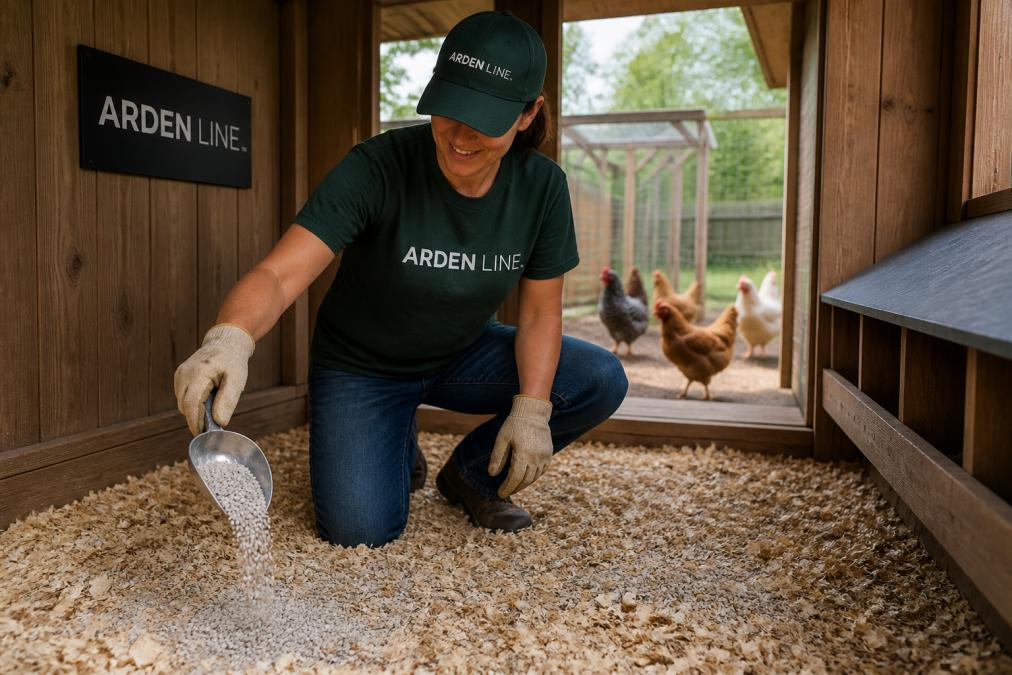
Application technique matters as much as frequency. A natural coop refresher for ammonia only works when the mineral contacts the waste and the gas. Scatter it evenly across the litter surface, working it into the top inch with a rake or fork, and pay extra attention to roosting areas and nesting boxes.
How Much to Apply per Square Foot
A light, even layer is the goal, not a thick blanket. For standard bedding, aim for a thin dusting that covers the surface without burying it. Roughly a cup per square foot of coop floor is a reasonable starting point, then adjust up for deep litter or dense flocks.
Three application rules that keep it effective:
- Sprinkle, do not dump. Piles waste product and do nothing for the gas between them.
- Work it in lightly. The top inch is where ammonia forms.
- Reapply after every bedding change. Fresh bedding has no mineral in it yet.
Applying a heavy layer does not extend the interval. Once the mineral's pores are saturated with ammonia and moisture, extra product on top does nothing until the saturated layer is removed. Over-application wastes money and makes the litter harder to manage.
Signs It Is Time to Reapply (and When You Are Overdoing It)
Your nose is a decent meter, but it is not the only one. Reapply when you notice any of these signals:
- A sharp ammonia smell at bird height, not just near the floor
- Damp, clumping litter when you squeeze a handful
- Visible caked droppings under the roosting bars
- Birds showing respiratory irritation, such as sneezing or head shaking
- Bedding that has visibly darkened and matted
Conclusion
Every coop has its own ammonia clock, and it runs faster in humid weather, dense flocks, and deep litter. The keepers who stay ahead of it are the ones who fix moisture first, apply consistently, and reapply based on what the litter is actually telling them. Arden Line makes that easier with a 100% natural zeolite deodorizer that traps ammonia and moisture at the source, is fragrance-free and chemical-free, and comes in plastic-free packaging.
Frequently Asked Questions
How often should you apply odor neutralizer to a chicken coop?
For most backyard coops, apply a light layer of coop odor neutralizer every 3 to 7 days, then refresh it fully at each bedding change. Coops with 8 or more birds, poor drainage, or deep litter may need reapplication every 2 to 3 days. Check the bedding by hand: if it feels damp or smells sharp, it is time to reapply. A 12 lb bag of Arden Line zeolite typically lasts several weeks at this pace.
Does the frequency of odor neutralizer application change with the seasons?
Yes. Heat speeds up microbial activity in droppings, so ammonia builds faster and you will likely reapply every 2 to 4 days. Coops that stay closed longer with less ventilation, trapping moisture and gas, may require a slightly heavier application once a week rather than frequent light dustings. Other times of the year usually settle into the standard 3 to 7 day rhythm.
How does moisture level affect how often you need to treat the coop?
Moisture is the biggest driver of reapplication timing. Zeolite traps ammonia gas and excess water, but once the mineral is saturated it stops working. If bedding feels damp, drinkers spill often, or your coop sits in a low spot, you will need to reapply sooner. Fixing leaks, raising waterers, and improving airflow reduces how often you need to treat.
Can you apply too much mineral-based odor neutralizer?
Overapplying wastes product and can leave a thick, dusty layer that clings to feathers and gets tracked into the house. A thin, even sprinkle across the bedding surface is enough. If you see visible piles of granules or the coop floor looks gray rather than lightly dusted, you have used too much. Reapply less product more often rather than dumping a heavy layer at once.


Leave a comment
This site is protected by hCaptcha and the hCaptcha Privacy Policy and Terms of Service apply.