
Table of Contents
- Why Mineral Coop Supplements Are Essential for Backyard Flocks
- Zeolite vs. Diatomaceous Earth: Which Mineral Amendment Wins?
- The Benefits of Volcanic Minerals for Poultry Health
- Natural Coop Odor Control Methods: How Zeolite Traps Ammonia
- Does Zeolite Help with Soil Compaction in Chicken Runs?
- How to Choose the Best Mineral Coop Supplement for Your Setup
- What Matters Most: Purity, Sourcing, and Application Tips
- Frequently Asked Questions
Last Updated: September 7, 2026
Why Mineral Coop Supplements Are Essential for Backyard Flocks
Raising backyard chickens in a confined coop creates an environment where moisture, ammonia, and pathogens build up faster than most keepers expect. The best mineral coop supplements for 2026 address this by tackling the root cause of coop odor and flock discomfort rather than masking symptoms with fragrances. The shift toward zeolite-based products reflects a broader move away from chemical additives in poultry care.
Mineral coop supplements are natural amendments added to bedding, feed, or the run itself to manage moisture, bind ammonia, and support overall flock health. Unlike chemical deodorizers that simply cover smells, these minerals physically alter the coop environment, resulting in drier bedding, cleaner feathers, and a noticeable reduction in the sharp ammonia smell that irritates both birds and their owners.
Zeolite vs. Diatomaceous Earth: Which Mineral Amendment Wins?
Many keepers default to diatomaceous earth because it's familiar, but zeolite operates on a completely different principle. Diatomaceous earth works primarily as a mechanical pest deterrent through abrasion. Zeolite, by contrast, is a volcanic mineral with a crystalline structure that acts like a molecular sieve, trapping ammonia, moisture, and odors within its porous framework.
For coop management, zeolite wins on versatility, handling wet bedding, ammonia fumes, and lingering odor. Diatomaceous earth remains useful for dust baths and targeted pest control, but it does little to address moisture or gas buildup. A common approach is to use both, assigning each mineral to the job it does best rather than treating them as direct substitutes.
The Chemical Difference That Matters
The distinction goes beyond marketing. Zeolite is a hydrated aluminosilicate mineral with a negative charge that acts like a magnet for positively charged ammonium ions (NH₄⁺) and water molecules. Clinoptilolite, the most common zeolite used in coop supplements, typically has a cation exchange capacity (CEC) of 150 to 180 meq/100g (PubMed). Diatomaceous earth, which is primarily amorphous silica, has virtually no CEC; it cannot bind ammonia, only physically abrade insect exoskeletons.
This is why zeolite is the only one of the two that addresses the root cause of coop odor. When a bird's droppings decompose, urease enzymes convert uric acid into ammonia gas. Zeolite captures the ammonium ion before it volatilizes into the air you and your birds breathe. Diatomaceous earth, no matter how finely milled, simply cannot perform this function.
Particle Size and Dust: A Practical Trade-Off
Both minerals come in varying particle sizes, and this is where keepers often make a mistake. Food-grade diatomaceous earth is milled to a fine powder, effective for pest control but creating respirable dust that can irritate both human and avian respiratory tracts in a confined coop. Zeolite for coop use is typically sold as a granular or pelleted product, keeping dust low while still providing a high surface area for ion exchange.
If you're using diatomaceous earth for pest control, apply it sparingly to nesting boxes and dust-bathing areas rather than broadcasting it across the entire bedding. For zeolite, a coarser granule (roughly 1-3 mm) is ideal for bedding integration because it won't blow around or get inhaled. Some products combine both minerals, but unless the label specifies the ratio and particle size, you're better off buying them separately and applying each where it works best.
A Note on Human-Grade vs. Agricultural-Grade Zeolite
The supplement aisle now includes zeolite marketed for human detox protocols, and the agricultural section carries bulk zeolite for livestock. These are not the same product. Human-grade zeolite is processed to a finer particle size and tested for heavy metal content, but it is significantly more expensive per pound. Agricultural-grade zeolite is perfectly safe for coop use, provided it comes from a reputable source that tests for lead, arsenic, and cadmium. The key is to look for a Certificate of Analysis (COA) from the manufacturer, regardless of whether the bag says "human-grade" or "agricultural-grade." A COA confirms the mineral has been screened for contaminants, which matters more than the marketing label.
The Benefits of Volcanic Minerals for Poultry Health
Volcanic minerals like zeolite contribute to poultry health through a cleaner living environment, which translates to better respiratory function and feather condition. When ammonia levels in a coop stay high, birds experience eye irritation and respiratory stress that can suppress appetite and activity. By continuously trapping that gas, zeolite supports the kind of air quality that lets a flock thrive.
The benefits extend beyond the air. Drier bedding means fewer instances of footpad dermatitis and breast blisters, conditions that develop when birds stand on wet, compacted litter. Cleaner feathers also provide better insulation and natural protection against external parasites. For keepers focused on preventative nutrition and health optimization, managing the coop environment is just as important as what goes into the feed bowl.
Natural Coop Odor Control Methods: How Zeolite Traps Ammonia
Natural coop odor control methods center on removing the compounds that cause smell, not covering them up. Zeolite's honeycomb-like structure physically captures ammonium ions and water molecules, holding them inside the crystal until the bedding is changed out. This is why a zeolite-treated coop stays fresher for days longer than one relying on lime or scented sprays.
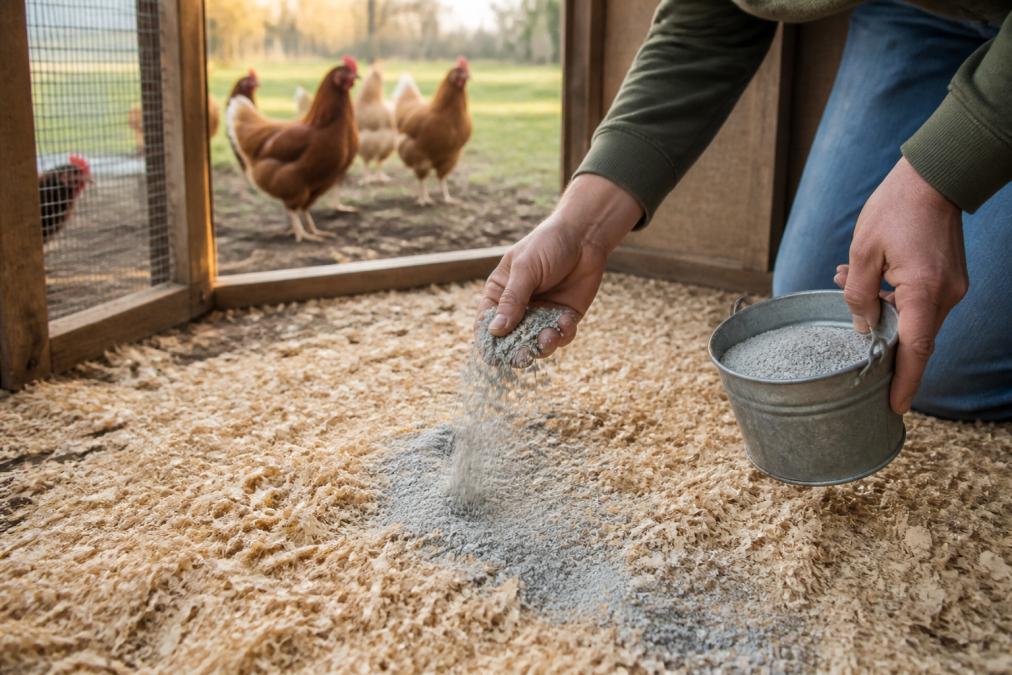
Application is straightforward. Sprinkle a light, even layer over fresh bedding at a rate that suits your coop size, then reapply when you top up shavings or notice moisture building up in high-traffic areas. For an average backyard coop, a single application can keep ammonia in check for an extended period, reducing the maintenance commitment compared to daily scooping and spraying routines.
Does Zeolite Help with Soil Compaction in Chicken Runs?
Yes, zeolite helps with soil compaction, though it addresses the symptoms rather than the underlying cause. In a chicken run, soil becomes compacted primarily from constant scratching and the weight of birds pressing down on wet ground. Zeolite improves drainage and aeration when worked into the top few inches of soil, helping the ground recover between wet periods.
The distinction matters for keepers wondering whether zeolite solves a drainage problem or a compaction problem. Zeolite excels at moisture management and nutrient retention, making it a strong addition to runs that stay soggy. For true compaction caused by heavy clay, zeolite alone won't break up that dense layer. You'll need to combine it with aeration, such as turning the soil and adding coarse organic matter, to restore structure. Think of zeolite as the moisture regulator that keeps conditions from worsening, not a substitute for physical soil cultivation.
How Zeolite Interacts with Soil Nutrients
Zeolite's ion-exchange capacity doesn't stop at ammonia. In soil, zeolite also holds onto potassium (K⁺) and ammonium (NH₄⁺), releasing them slowly over time. This is why zeolite-amended runs often show greener grass or healthier plants around the perimeter. But there's a trade-off keepers rarely hear about: zeolite has a higher affinity for certain cations over others. The selectivity sequence for clinoptilolite is typically: Cs⁺ > Rb⁺ > K⁺ > NH₄⁺ > Pb²⁺ > Ag⁺ > Ba²⁺ > Na⁺ > Ca²⁺ > Fe²⁺ > Al³⁺ > Mg²⁺ > Li⁺.
What this means in practice is that zeolite will preferentially bind potassium and ammonium over calcium and magnesium. In a chicken run that receives regular manure deposits, this is usually fine because manure is rich in all these nutrients. But if you're also adding zeolite to your garden soil, you may need to monitor calcium and magnesium levels, as the zeolite can hold onto those less tightly and they may leach out faster than expected.
Application Rates for Run Soil
For a standard backyard run (roughly 100-200 square feet for 6-8 birds), a common pattern is to work 5-10 pounds of granular zeolite into the top 2-3 inches of soil per 100 square feet. This is not a one-time fix. Zeolite will eventually become saturated with ammonium and other cations, typically after 6-12 months of continuous exposure to manure. At that point, its ion-exchange capacity is exhausted, and it becomes inert filler. The solution is to rake the top layer, remove the saturated zeolite, and add a fresh application.
Some keepers ask whether they can compost the spent zeolite. Yes, and this is where the mineral adds value beyond the run. Saturated zeolite that has captured ammonium makes an excellent slow-release nitrogen amendment for flower beds or non-edible landscaping. However, if you've used zeolite in a high-traffic area where birds may have deposited pathogens, it's safer to compost it at high temperatures (above 130°F) before applying it to edible gardens.
The Synergistic Nutrient Angle Most Articles Miss
Here's a connection that rarely appears in coop supplement guides: the minerals you add to the soil can affect the mineral profile of the plants that grow there, which in turn affects your birds if they free-range and forage. Zeolite's ability to hold potassium and ammonium can shift the cation balance in soil. If you're also supplementing your flock with calcium (oyster shell) or magnesium, those minerals pass through the birds and end up in the manure. Zeolite may bind those less effectively, meaning they stay more available for plant uptake.
This creates an opportunity for keepers who want to close the loop on their backyard ecosystem. By testing your soil every 12-18 months and adjusting your zeolite application based on the results, you can maintain a run that stays dry, odor-free, and productive for forage. A simple soil test from a university extension service (typically $15-$25) will tell you whether your cation balance is shifting in ways that could affect plant health or bird nutrition (ag.umass.edu).
When Zeolite Is Not the Answer
If your run sits on heavy clay that stays waterlogged even in dry spells, zeolite alone won't fix the drainage problem. Clay particles are microscopic and pack tightly, creating a barrier that zeolite granules (even at 1-3 mm) cannot penetrate. In this case, you need physical intervention first: core aeration, sand incorporation, or raised bedding. Zeolite works best as a complement to good drainage practices, not as a replacement for them.
Similarly, if your compaction problem stems from too many birds in too small a space, no mineral amendment will solve it. Industry standards suggest a maximum stocking density of 2 pounds of bird per square foot of outdoor run space (extension.psu.edu). Exceeding that means the soil never gets a chance to recover, regardless of what you add to it. Managing bird numbers and rotating run access are the only long-term fixes for compaction caused by overstocking.
How to Choose the Best Mineral Coop Supplement for Your Setup
Choosing the best mineral coop supplement for your setup comes down to purity, particle size, and how the product fits your specific coop conditions. Start by confirming the source. A supplement approved for use in organic production carries weight because it signals the mineral has been processed without chemical additives or synthetic carriers. Check for third-party certification like OMRI Listing, which verifies the product meets strict input standards.
Particle size affects how the mineral behaves in your coop. A finer powder distributes easily through bedding but can become dusty in a dry environment. A slightly granular texture stays where you put it, which matters if you're concerned about tracking dust through your house or garden. Consider how many birds you keep and how often you clean the coop. A small backyard flock needs far less product than a larger operation, so match the application rate to your actual setup rather than defaulting to a one-size-fits-all approach.
| Consideration | What to Look For | Why It Matters |
|---|---|---|
| Purity | 100% natural volcanic zeolite | Avoids chemical additives and synthetic fragrances |
| Certification | OMRI Listed | Confirms suitability for organic production |
| Particle size | Granular, not fine dust | Stays in place, minimizes tracking |
| Sourcing | Family-made in the USA | Supports consistent quality and traceability |
| Packaging | Plastic-free options | Aligns with sustainable, chemical-free living |
What Matters Most: Purity, Sourcing, and Application Tips
The supplement industry is fragmented, with products ranging from agricultural-grade bulk minerals to refined human-grade options. Agricultural-grade zeolite may contain inconsistent particle sizes and potential contaminants that don't meet the standards for a backyard environment. OMRI-listed mineral supplements close that gap, offering a consistent nutrient profile you can trust around food-producing animals.
When you compare prices, remember that a pure, certified product goes further because you don't need to over-apply to compensate for filler. A single bag can last for an extended period for a small flock, depending on how often you clean the coop and how many birds you keep. Reapplication aligns with your bedding change schedule, making the maintenance commitment predictable.
The best mineral coop supplements for 2026 share one trait: they work with natural processes rather than against them. By choosing a pure volcanic zeolite product, you're investing in a solution that manages moisture, traps ammonia, and supports healthier birds without introducing chemicals into your backyard ecosystem.
Frequently Asked Questions
Is zeolite safe to use around my chickens and in my garden?
Yes, natural zeolite is safe for poultry and soil. Unlike chemical additives, it works through physical absorption and ion exchange. Look for a product that is OMRI Listed to ensure it meets organic production standards. This certification confirms it is free from synthetic additives and safe for both your flock and your vegetable garden.
How often should I apply mineral coop supplements to the bedding?
The application frequency depends on your flock size and coop conditions. For a standard small backyard coop, a fresh application with each full bedding change is a good starting point. You can also add a light dusting to high-traffic areas, like under roosts, weekly to manage moisture and ammonia between deep cleanings.
What is the difference between feed-grade zeolite and coop-grade zeolite?
Feed-grade zeolite is processed for consumption and is added to feed to aid digestion and nutrient absorption. Coop-grade zeolite is typically a larger particle size designed for top dressing bedding and managing moisture. For odor control and coop hygiene, a coarse granular product is the right choice, as it lasts longer and is less dusty in the run.
Choosing the right mineral amendment doesn't have to be complicated, but it does require attention to sourcing and purity. Arden Line offers 100% natural volcanic zeolite that is OMRI Listed, chemical-free, and family-made in the USA, packaged in plastic-free kraft boxes. Add to cart and give your flock the clean, ammonia-free environment they deserve.

Leave a comment
This site is protected by hCaptcha and the hCaptcha Privacy Policy and Terms of Service apply.