
Table of Contents
- What Volcanic Minerals Are and Why They Matter in Garden Soil
- How to Improve Drainage in Clay Garden Soil with Volcanic Minerals
- The Benefits of Zeolite for Soil: Nutrient Retention and Moisture Control
- Remineralizing Garden Soil with Rock Dust: Slow-Release Trace Elements
- How Volcanic Minerals Boost Plant Resilience and Drought Resistance
- Application Rates, Frequency, and Safety for Volcanic Mineral Amendments
- Frequently Asked Questions
Last Updated: September 17, 2026
What Volcanic Minerals Are and Why They Matter in Garden Soil
Volcanic minerals for home gardens are naturally occurring, porous minerals formed when lava flows cool and weather over time, and they improve soil structure, nutrient retention, and moisture control. This guide from Arden Line explains how these minerals work and how to use them.
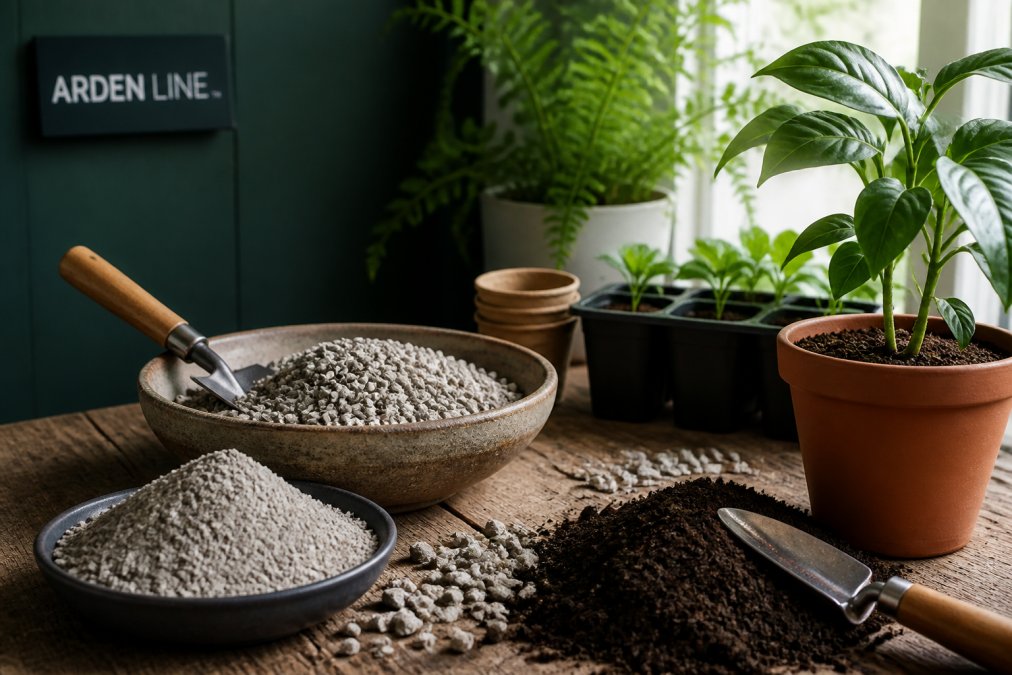
The most common garden variety is zeolite, a mineral with a honeycomb-like internal structure. That structure gives zeolite an unusually high cation exchange capacity, meaning it holds positively charged nutrients like potassium, magnesium, and ammonium in the root zone instead of letting them wash away. Volcanic ash and basaltic rock break down into similar mineral-rich material over long periods.
Most garden soils have been worked hard for decades. Mineral depletion is common, and synthetic fertilizers replace only a few key nutrients, not the broad spectrum of trace elements that healthy soil once held. Volcanic minerals offer a slow-release way to rebuild that nutrient density.
How to Improve Drainage in Clay Garden Soil with Volcanic Minerals
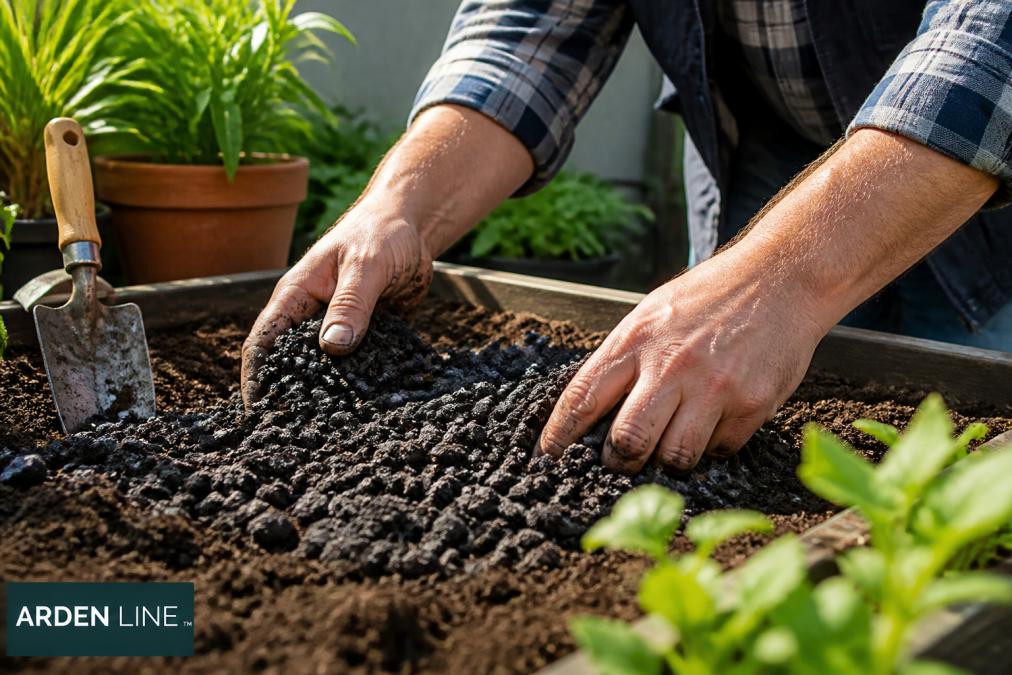
Learning how to improve drainage in clay garden soil starts with understanding what clay actually does: it compacts, holds water tightly, and leaves little room for air. Volcanic minerals address the aeration side of that problem by creating permanent pore space in the soil.
Clay particles are tiny and flat, so they pack together and squeeze out oxygen. Roots need both water and air, and compacted clay gives them mostly water. Zeolite granules, sized between 1/8" and 1/4", sit in the soil as rigid, porous structures that water can pass through and around rather than pooling on top.
A common mistake is adding sand to clay, which can create a concrete-like mix. Mineral amendments behave differently because they do not break down. Zeolite is a long-lasting mineral that holds its structure for years, so one application keeps working.
For containers and raised beds, the granular grade blends more evenly into potting mixes. For heavier in-ground clay, the regular grade opens channels faster.

The Benefits of Zeolite for Soil: Nutrient Retention and Moisture Control
The benefits of zeolite for soil come down to two jobs: it holds water that would otherwise drain away, and it holds nutrients that would otherwise leach out. Both happen because of the mineral's porous structure and negative surface charge.
When you water, zeolite absorbs excess moisture and releases it back slowly as the soil dries. That buffer matters most in sandy soils and containers, where water moves through fast. It also helps prevent overwatering, a common cause of root rot in houseplants and succulents.
On the nutrient side, zeolite traps ammonium and potassium in its pores. Plants draw these out gradually rather than getting a single flush that washes past the roots. The result is steadier growth with less fertilizer runoff.
Arden Line's Zeolite Mineral Lava Rocks come in two grades: Regular (1/8"-1/4") for in-ground beds and larger containers, and Granular (1.4-4 mm) for potting mixes. Both are 100% natural clinoptilolite with a pH of approximately 8.5, so they fit many soil blends. You can shop the Regular grade or the Granular grade depending on your setup.

Remineralizing Garden Soil with Rock Dust: Slow-Release Trace Elements
Remineralizing garden soil with rock dust means rebuilding the broad spectrum of minerals that years of growing and harvesting strip out. Rock dust is finely ground volcanic or basaltic rock that releases trace elements slowly as it weathers in the soil.
Unlike a soluble fertilizer, rock dust does not deliver a quick hit. Microbial activity and natural mineral weathering break it down over months and years, feeding micro-nutrients like iron, manganese, and zinc into the soil food web. This is why rock dust works best as part of a long-term soil fertility plan rather than a single-season fix.
Zeolite Mineral Lava Rocks (Regular) →
The practical difference from synthetic inputs is bioavailability. Nutrients bound in rock dust become available at the pace plants and soil organisms can use them, which reduces the risk of burning roots or creating nutrient imbalances. Pairing rock dust with a moisture-holding mineral like zeolite gives you both slow-release minerals and steady moisture.
Many organic gardeners apply rock dust once or twice a year and let soil biology do the rest. It is not fast, but it builds soil vitality that compounds.
How Volcanic Minerals Boost Plant Resilience and Drought Resistance
Volcanic minerals strengthen plant resilience through three distinct mechanisms: moisture buffering in the root zone, silica deposition in cell walls, and pH buffering that keeps nutrients available during stress. Each one shows up differently when a plant is under pressure.
Moisture buffering. Zeolite's honeycomb lattice holds water in its internal pores and releases it back as the surrounding soil dries. In a sandy loam, that can extend the window between waterings by a meaningful margin during a dry stretch. The effect is most pronounced in containers and raised beds, where the total soil volume is small and dries out fast. In heavy clay, the benefit shifts from water storage to aeration, because the granules keep pore space open when clay would otherwise seal it shut.
Silica and cell wall strength. Volcanic rock, ash, and basalt are rich in silicon dioxide. Plants take up soluble silicic acid through their roots and deposit it as amorphous silica in the epidermis, the outer cell layer. That silica layer acts like a thin mineral armor: it stiffens stems, reduces lodging in tall crops like tomatoes and peppers, and makes leaf surfaces harder for chewing insects and fungal hyphae to penetrate. The effect is not a pesticide. It is structural. A common pattern among growers who amend with silica-rich minerals is that plants stand up better to wind, heat, and sap-sucking pests without any change to their spray schedule.
pH buffering during stress. This is the angle most guides skip. Zeolite has a high cation exchange capacity and a naturally alkaline pH, typically around 8.5 for clinoptilolite. In acidic soils, that alkalinity buffers pH upward slowly, which can unlock phosphorus that was tied up by aluminum and iron. In already-alkaline soils, the same mineral can push pH higher and lock out iron, manganese, and zinc. The practical takeaway: test your soil pH before amending, and if you are already above 7.5, pair zeolite with acidic inputs like peat moss, pine bark fines, or elemental sulfur. Rock dust behaves differently. It is closer to neutral and releases minerals without the same pH lift, which makes it the safer choice for alkaline gardens.
Drought resistance in practice. During a dry spell, a plant with silica-reinforced cell walls and a moisture reservoir at its roots has two advantages: it loses water more slowly through transpiration, and it has more water available when it needs it.
Application Rates, Frequency, and Safety for Volcanic Mineral Amendments
Most guides hand-wave application rates. Here are concrete numbers you can actually measure, plus the compatibility and safety details that competitors leave out.
| Situation | Amendment | Rate | Frequency |
|---|---|---|---|
| Raised beds, in-ground clay | Regular zeolite (1/8"-1/4") | 1-2 cu ft per 10 sq ft at 6" depth | Once, top up as needed |
| Sandy soil, fast drainage | Regular zeolite | 2 cu ft per 10 sq ft | Once |
| Potting mixes, containers | Granular zeolite (1.4-4 mm) | 1-2 cups per cu ft of mix | Once per repot |
| Broad bed remineralizing | Rock dust | 2-5 lb per 100 sq ft | 1-2 times per year |
Frequently Asked Questions
What is the difference between lava rock mulch and volcanic mineral amendments?
Lava rock mulch consists of larger stones used as a decorative top layer to suppress weeds and retain moisture. Volcanic mineral amendments like zeolite are smaller, porous granules mixed directly into soil to improve drainage, aeration, and nutrient retention at the root zone. Mulch sits on the surface; amendments work within the soil. For clay-heavy gardens, mineral amendments address compaction and waterlogging, while mulch mainly reduces evaporation and blocks weeds. Combining both can be effective, but they serve different purposes.
How much zeolite should I add to my garden soil?
For garden beds, a common rate is 5 to 10 percent zeolite by volume, which means roughly 1 to 2 cups per cubic foot of soil. For containers, mix 10 to 20 percent zeolite into your potting blend. Arden Line Zeolite Regular (1/8 to 1/4 inch) works well for raised beds and larger plantings, while the Granular grade (1.4 to 4 mm) blends smoothly into potting mixes for succulents, orchids, and houseplants. Always water thoroughly after application and monitor soil moisture for the first few weeks.
Can volcanic minerals help with moisture retention in clay soil?
Yes. Volcanic minerals like zeolite have a porous, honeycomb structure that holds water and releases it slowly, which helps clay soil manage moisture more evenly. They also improve soil structure by creating air pockets that reduce compaction, allowing roots to access both water and oxygen. In clay soil, zeolite does not replace the need for organic matter, but it works alongside compost to improve drainage and prevent waterlogged roots. Apply 5 to 10 percent by volume and mix it into the top 6 to 8 inches of soil.
Is volcanic mineral powder considered an organic fertilizer?
Volcanic mineral powder is not a fertilizer in the traditional sense because it does not supply the primary nutrients nitrogen, phosphorus, and potassium in concentrated amounts. Instead, it is a soil amendment that provides trace elements and improves soil structure over time. Some volcanic minerals like zeolite can hold positively charged nutrients such as potassium and ammonium in the root zone, making them available to plants gradually. For organic gardening, look for products approved for organic production, such as OMRI Listed minerals.

Leave a comment
This site is protected by hCaptcha and the hCaptcha Privacy Policy and Terms of Service apply.