
Table of Contents
- What Is Zeolite and Why Backyard Chicken Keepers Use It
- Is Zeolite Safe for Backyard Chickens to Ingest?
- Zeolite for Chicken Coop Odor: How Much to Use and How Often
- Zeolite Dust Bath for Chickens: A Natural Alternative to DE
- Does Zeolite Help with Soil Compaction? Using Spent Coop Zeolite in the Garden
- Common Mistakes When Using Zeolite in a Backyard Coop
- Frequently Asked Questions
Last Updated: September 10, 2026
What Is Zeolite and Why Backyard Chicken Keepers Use It
Zeolite is a naturally occurring volcanic mineral with a honeycomb structure that traps ammonia and moisture. This guide from Arden Line explains why backyard chicken keepers add it to coops, dust baths, and gardens, and what "zeolite safe" actually means in practice.
The mineral forms when volcanic ash reacts with alkaline groundwater over thousands of years. That process leaves behind a rigid lattice of tiny pores, and those pores carry a negative charge. Ammonia gas carries a positive charge. Put the two together and the ammonia sticks to the mineral instead of rising into the air your flock breathes.
How Zeolite's Structure Traps Ammonia and Moisture
The cage-like framework gives zeolite what chemists call cation exchange capacity: the ability to hold positively charged ions, including ammonium, on its surface. Moisture absorption works on the same principle. Water vapor and liquid collect inside the pores rather than pooling on the coop floor.
That dual action is why the mineral shows up in litter additives and feed additives across poultry management.
Is Zeolite Safe for Backyard Chickens to Ingest?
Yes. Food-grade zeolite is safe for backyard chickens to ingest in small amounts, and it has a long history of use as a feed additive and mineral supplement in commercial poultry production (the FDA). The safety record rests on two conditions: the product must be purified and labeled for feed or agricultural use, and it must be free of the contaminants found in industrial grades.
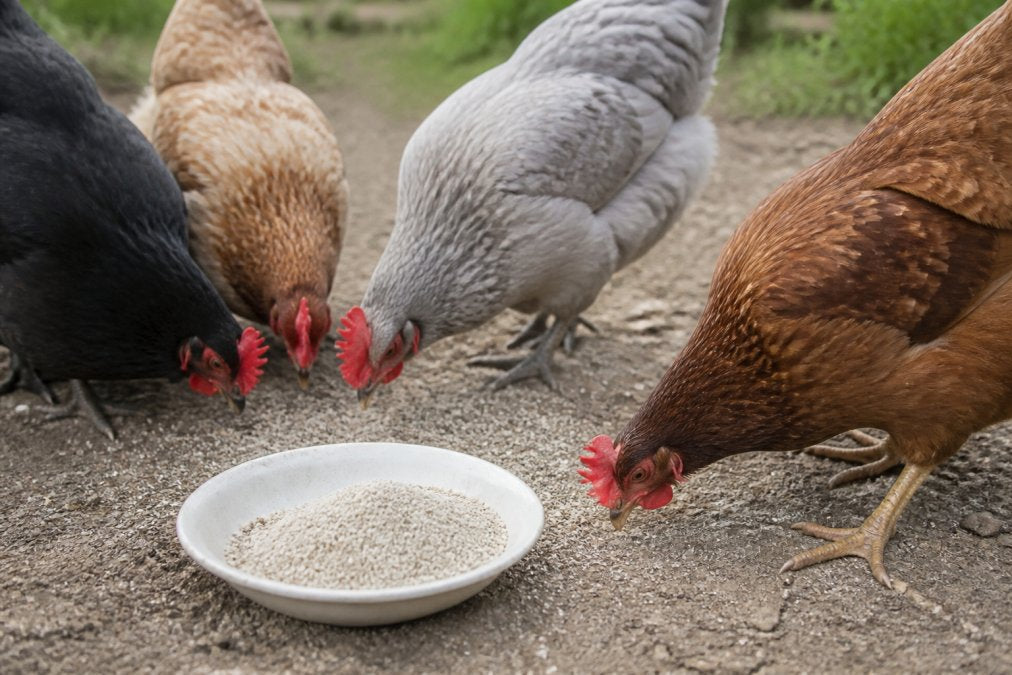
Chickens pick up zeolite the same way they pick up grit. A hen scratching through treated litter or taking a dust bath will swallow a small amount, and that is not a cause for concern with a properly sourced product. The mineral passes through the digestive tract largely unchanged, which is why it shows up in commercial feed formulations as an anti-caking and pellet-binding agent. Respiratory safety matters too. Any fine powder, zeolite included, can irritate a bird's airways if it fills the air during application, so pour it low and slow rather than tossing it in a cloud.

Food-Grade vs. Industrial Zeolite: What the Label Should Say
Food-grade zeolite is purified to remove heavy metals and other contaminants, while industrial zeolite is not held to the same standard. The label is where you separate the two, and most problems people report trace back to buying the wrong grade.
Look for these on the packaging:
- A feed or agricultural use designation, not a "for industrial use only" warning
- A named mineral source or mine, not just "zeolite"
- A particle size listed in millimeters or mesh, since fine powder and coarse granules behave very differently
- An organic certification listing if you sell eggs or meat as organic
- A clinoptilolite specification, since clinoptilolite is the zeolite species most studied for feed and litter use
How to Verify a Supplier Before You Buy
Grade claims on a bag are only as good as the supplier behind them. A few practical checks separate a real feed-grade product from repackaged industrial material:
- Ask for a certificate of analysis (COA). Reputable feed-grade suppliers provide one on request. It should list the zeolite species, cation exchange capacity, and heavy-metal limits.
- Check the intended-use statement. Feed-grade bags say so explicitly. Bags sold for water filtration, aquarium use, or industrial odor control are not the same product even when the mineral looks identical.
- Match particle size to the job. Fine powder for dust baths and feed blending; coarse granules for litter. A bag that does not state a size is a red flag.
- Be skeptical of unusually cheap bulk material. Price is not a perfect signal of quality, but industrial-grade zeolite is often sold in large bags at prices that feed-grade material cannot match.
What About Long-Term Ingestion?
Backyard keepers sometimes worry that a hen eating zeolite off the coop floor day after day will accumulate it. In practice, the amounts a bird picks up incidentally, a few grams at most from litter and dust baths, are far below the inclusion rates used in commercial feed, where zeolite is blended in at controlled percentages. The mineral is not metabolized and does not build up in tissue the way some additives can. The bigger variable is grade, not quantity: a properly sourced feed-grade product at incidental exposure levels is not a concern, while an industrial-grade product is a concern at any level.
Zeolite for Chicken Coop Odor: How Much to Use and How Often
For coop odor control, the practical rule most keepers land on is a light, even layer across the litter, roughly one cup of granular zeolite per 10 square feet of coop floor as a starting point, reapplied as the surface becomes saturated. Exact ratios depend on flock size, bedding type, ventilation, and how wet your climate runs, so treat any number as a starting point and adjust from there. USDA guidance on poultry facility air quality is a useful reference for why ammonia control matters to flock health in the first place.
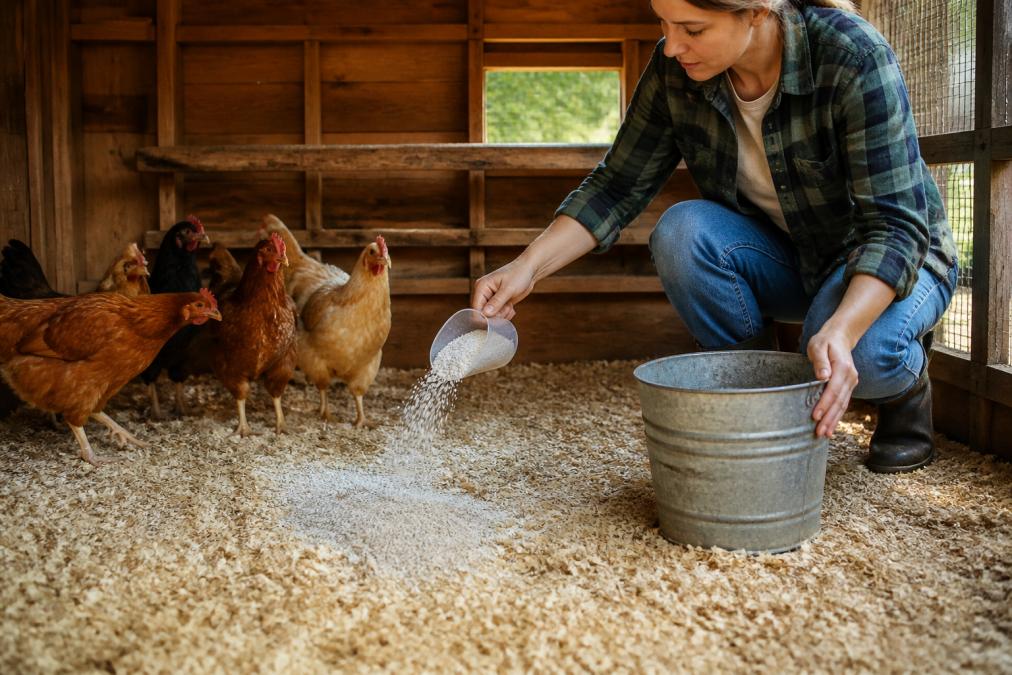
Ammonia builds up fastest in small coops with poor airflow, which is exactly the situation most backyard keepers face (usda.gov). The mineral buys you time between cleanouts, but it does not replace them. A coop that smells sharp within three days of a fresh application is telling you the problem is ventilation or moisture, not a shortage of zeolite.
Application Ratios for Small Backyard Coops
For a small backyard coop, the practical approach is to spread a light, even layer over the litter, work it into the top inch or so, and reapply when you notice odor returning. That rhythm usually means reapplying every week or two in a small coop and less often in a larger, well-ventilated one.
A simple schedule to work from:
| Coop Situation | Application Approach | Reapply |
|---|---|---|
| Small coop, 4-8 birds, deep litter | ~1 cup per 10 sq ft, worked into top inch | Every 1-2 weeks |
| Larger coop, good ventilation | Thin layer on dropping boards and litter | Every 2-4 weeks |
| Dust bath area | Blend into the bathing material | When it clumps or looks soiled |
| Full cleanout | Fresh layer after removing old litter | At each cleanout |
Why Particle Size Changes the Application Rate
The number on the bag matters as much as the number you scoop. Fine zeolite (often sold as powder or 0-2 mm) covers more surface area per pound and grabs ammonia faster, but it also throws more dust and settles into bedding where birds can kick it around. Coarse granules (roughly 2-6 mm) last longer in the litter, resist being scratched into corners, and are the better choice for dropping boards and deep-litter floors.
A common pattern is to use coarse granules as the base layer in the litter and reserve fine material for dust baths and spot treatment under roosts. If you only buy one grade, coarse is the safer default for coop floors because it stays where you put it.
Reading the Signs That It Is Time to Reapply
Zeolite does not announce when it is full. The cues are indirect:
- Odor returns at nose level. If you can smell ammonia standing at the coop door, the surface layer is saturated.
- Litter feels damp to the touch. Saturated zeolite stops absorbing moisture, so wet bedding is a signal, not a cause.
- Droppings stop clumping. Fresh zeolite pulls moisture out of droppings and firms them up. When they stay soft and smear, the mineral is spent.
- You have done a full cleanout. Old litter goes out, fresh zeolite goes in.
Arden Line's zeolite coop deodorizer is milled for exactly this job.

Zeolite Dust Bath for Chickens: A Natural Alternative to DE
Zeolite works well as a dust bath material and makes a reasonable alternative to diatomaceous earth for keepers who want a mineral that does not rely on abrasive action. The two work differently. DE kills mites and lice by abrading their outer shell, while zeolite absorbs moisture and odor from the feathers and the surrounding dust.
For flock health, the practical difference is that zeolite does not dry out skin the way heavy DE use can, and it does not create the same fine silica dust cloud. A dust bath blended from zeolite, dry soil, and a little wood ash gives birds something to work through that also helps keep feathers clean and dry.
What most guides miss is the moisture angle. A damp dust bath is a poor dust bath, and zeolite's moisture absorption keeps the bathing material loose and usable longer. Arden Line's chicken dust bath is milled fine for this purpose and comes in plastic-free packaging.
Does Zeolite Help with Soil Compaction? Using Spent Coop Zeolite in the Garden
Spent coop zeolite can help with soil compaction, but only as part of a broader fix. The mineral improves soil structure by holding moisture and nutrients and by keeping clay particles from packing together so tightly, which improves drainage and aeration over time. It is an amendment, not a cure.
The distinction matters because compaction and poor drainage are not the same problem. Compacted clay needs organic matter, aeration, and often deep-rooted plants to break it up. Zeolite helps with the moisture and nutrient side and adds porosity, but a garden bed that has been driven over or walked on repeatedly needs more than a mineral additive.
Spent zeolite from the coop comes pre-loaded with nitrogen and organic matter, which makes it more valuable in the garden than fresh material. Spread it on beds, work it into the top few inches, and let it do its slow work. The long-term effect on soil is gradual, and the mineral does not break down, so it keeps contributing season after season.
Common Mistakes When Using Zeolite in a Backyard Coop
Most problems with zeolite trace back to grade, application, or expectations rather than the mineral itself.
- Buying industrial grade. Covered above, and still the most frequent error. Check the label every time.
- Expecting it to replace cleanouts. Zeolite manages ammonia between cleanouts. It does not eliminate the need for them.
- Applying it dry and fast. Pouring from height throws fine dust into the air where birds are breathing. Pour low and work it in.
- Using it in a wet coop. Saturated zeolite stops absorbing. Fix the leak or the drainage first.
- Skipping the dust bath blend. Straight zeolite in a bath works, but blending it with dry soil and ash gives birds better texture to work through.
One more point on sourcing: quality varies by mine and by processing, and price is not a perfect signal of either. What matters is the grade designation on the bag and whether the particle size suits the job. Fine material for dust baths, coarser granules for litter.
Ammonia control is one of those jobs that never really finishes, and the coops that smell clean are usually the ones where someone built a simple routine and stuck to it. Arden Line provides 100% natural volcanic zeolite that traps ammonia, moisture, and odor, supports clean and healthy feathers, and doubles as a soil amendment once it has done its work in the coop. Every product is chemical-free, fragrance-free, approved for organic production, and packed in plastic-free kraft packaging. Get started with Arden Line and build a coop routine that keeps the air clean and the litter working for you.
Frequently Asked Questions
Is zeolite safe for backyard chickens to ingest?
Yes. Food-grade zeolite is safe for chickens to ingest in small amounts, and some keepers mix it into feed as a mineral supplement. The key is using a product labeled food-grade or feed-grade, not industrial zeolite meant for water treatment or construction. Chickens that peck at zeolite scattered in the coop or dust bath are not at risk when the mineral is pure and non-toxic. If you are unsure about the grade, check the label or contact the supplier before use.
How does zeolite help manage ammonia levels in chicken coops?
Zeolite has a porous, cage-like structure that traps ammonia molecules through a process called cation exchange. When you spread zeolite on coop bedding or dropping boards, it captures the ammonia gas before it reaches the air. This reduces the sharp smell that builds up in enclosed coops and lowers environmental ammonia that can irritate a flock's respiratory system. Reapply every one to two weeks, or more often in humid weather, to keep ammonia reduction consistent.
Can zeolite be used in chicken dust baths?
Yes, finely milled zeolite works well in a dust bath. A zeolite dust bath for chickens helps absorb excess oil and moisture from feathers while providing gentle abrasion that discourages mites and lice. It is non-toxic and does not create the same airborne dust concerns as some other amendments. Fill a shallow container or tire with a mix of zeolite, sand, and wood ash, and place it in a dry, covered area so the flock can use it regularly.
Does zeolite improve egg production or shell quality?
Research on dietary zeolite in laying hens has looked at laying performance, egg quality, and even carcass characteristics, with some studies showing modest improvements when zeolite is added to feed. However, results vary by flock, diet, and zeolite source. Zeolite is not a substitute for a balanced layer feed or proper calcium intake. Think of it as a supportive mineral supplement, not a guaranteed production booster.


Leave a comment
This site is protected by hCaptcha and the hCaptcha Privacy Policy and Terms of Service apply.