
Table of Contents
- What Diatomaceous Earth Is and How It Works in a Coop
- Dangers of Diatomaceous Earth for Poultry
- How to Stop Chicken Coop Ammonia Smell Without Diatomaceous Earth
- Zeolite vs Diatomaceous Earth for Chicken Coops: Key Differences
- Pros and Cons of Using Diatomaceous Earth in Chicken Coops
- How to Use Diatomaceous Earth in Chicken Coops Safely (If You Choose To)
- Conclusion: Is Diatomaceous Earth Worth It for Your Flock?
- Frequently Asked Questions
Last Updated: September 28, 2026
What Diatomaceous Earth Is and How It Works in a Coop
Diatomaceous earth is a fine powder made from the fossilized shells of tiny water organisms called diatoms. Those shells contain silica, and when ground up, they feel like talc but act like tiny shards under a microscope.
The pest-control claim works like this: as insects crawl through the powder, those sharp particles scratch the waxy outer layer of their exoskeleton. Without that layer, the insect loses moisture and dies from dehydration. In a chicken coop, people spread it on bedding, in nesting boxes, and in dust bathing spots to target mites, lice, and fleas.

Here's the catch. That same abrasive action does not switch off for your birds. Whether is diatomaceous earth worth it for chicken coops depends less on the powder and more on how, where, and how often you use it.
Dangers of Diatomaceous Earth for Poultry
The biggest danger is the dust itself, and the risk depends on which grade you buy and how you handle it. Diatomaceous earth is largely amorphous silica, but most food-grade products still contain a small percentage of crystalline silica, and it is the crystalline fraction that regulators treat as the inhalation hazard. The Occupational Safety and Health Administration sets a permissible exposure limit for respirable crystalline silica, and the National Institute for Occupational Safety and Health recommends keeping exposure even lower. Those workplace numbers exist because fine silica particles reach deep into the lungs, and the body cannot easily clear them.
Chickens have a sensitive avian respiratory system. They lack the diaphragm and the mucus-clearing mechanics mammals rely on, and their air sacs run throughout the body. That anatomy means airborne powder that settles in a coop gets pulled through the entire respiratory tract, not just the nostrils. Repeated exposure to airborne powder can lead to respiratory irritation, and those effects build up over time rather than showing up overnight. A single dusty afternoon rarely causes a visible problem; a season of heavy application in a closed coop is a different story.
The dose and the frequency matter more than the product. A thin dusting in a nesting box is a very different exposure than a thick blanket across the floor.
Common mistakes we see:
- Applying it in a closed coop. Dust hangs in still air and the flock breathes it all night. Ventilate first, apply second, and let the air clear before birds return.
- Dusting the birds directly. This puts powder right next to the eyes and nostrils. Treat the environment, not the animal.
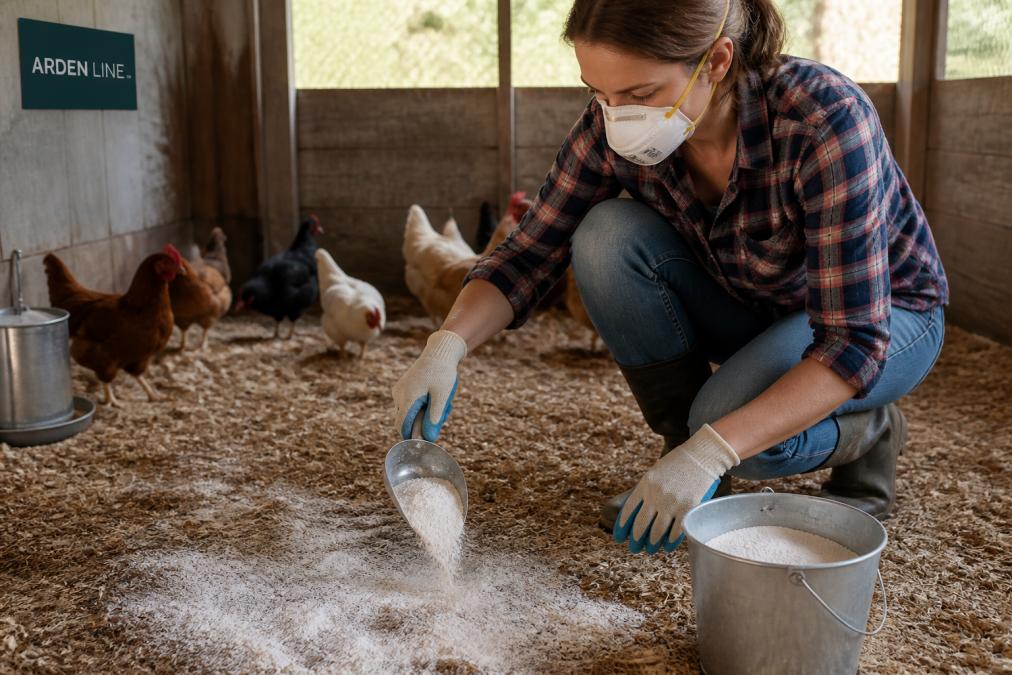
- Skipping a mask. Keepers inhale the same particles they are spreading. A simple N95 respirator or a well-fitted dust mask is the minimum, and it should be worn for the whole application, not just the pour.
- Using industrial-grade DE. This is not the same product as food grade. Industrial grades are filtered and heat-treated for filtration and pest-control uses, and they can carry a much higher crystalline silica content. They are not meant for animal areas.
- Reusing the same clothes indoors. Powder rides on sleeves and pant cuffs. Change and wash separately so you are not redistributing dust through the house.
A little powder goes a long way, and more is not better. If you can see a visible cloud while you work, you are applying too fast or too much.
How to Stop Chicken Coop Ammonia Smell Without Diatomaceous Earth
Diatomaceous earth does not fix ammonia. That is the part most guides skip.
Ammonia comes from urine and moisture breaking down in bedding. DE is a drying agent at best, and it does nothing to trap the gas once it forms. To actually cut the smell, you have to remove the moisture and the ammonia at the source.
What works:
- Keep bedding dry. Wet litter is the ammonia factory.
- Improve airflow. Ventilation moves gas out before it builds up.
- Use a mineral that traps ammonia. Zeolite is a porous volcanic mineral that adsorbs ammonia gas and moisture instead of masking them.
- Clean regularly. Remove soiled bedding before it breaks down.
For keepers who want a real fix, Arden Line's Chicken Coop Deodorizer is made from 100% natural zeolite. You sprinkle it over floors, bedding, and nesting boxes, and it traps ammonia and moisture at the source. No perfumes, no chemicals, and it is safe to use around the flock every day.

Zeolite vs Diatomaceous Earth for Chicken Coops: Key Differences
These two minerals get lumped together, but they solve different problems. Here is the short version.
| Feature | Diatomaceous Earth | Zeolite |
|---|---|---|
| Main job | Pest control | Ammonia and moisture control |
| How it works | Abrasive particles dry out insects | Porous structure traps gas and water |
| Ammonia smell | No effect | Traps it at the source |
| Dust concern | High (silica inhalation risk) | Low, stays where applied |
| Best for | Targeting mites and lice | Odor, damp bedding, coop freshness |
Diatomaceous earth is a pest tool. Zeolite is a hygiene tool. If your coop smells and the bedding stays damp, DE will not help. If mites are the problem, zeolite will not kill them.
Many keepers end up using both, but for different jobs. The mistake is expecting one mineral to do the work of the other.
Pros and Cons of Using Diatomaceous Earth in Chicken Coops
Is diatomaceous earth worth it for chicken coops? It depends on what you are trying to fix, and the honest answer requires looking past the forum anecdotes.
What the research actually shows. Diatomaceous earth works as an insecticide through a physical, not chemical, mechanism: the abrasive particles damage the waxy epicuticle layer of an insect's exoskeleton, and the insect loses water faster than it can replace it.
Pros:
- Kills mites, lice, and fleas by drying them out, with a physical mode of action
- Chemical-free, so no insecticide residue on eggs or in the coop
- Cheap and easy to find at most farm and garden stores
- Works in dust baths and nesting boxes where birds already groom
- Food-grade product is widely available and simple to store
Cons:
- Does nothing for ammonia or coop odor
- Silica dust is a real inhalation risk for birds and people, especially the crystalline fraction
- Loses effectiveness once it gets damp, so it needs reapplying after every bedding change or rain event
- Can irritate eyes and skin if overused
- Kills beneficial insects too, not just pests, so broadcast application in the run or garden is a net negative for pollinators and predatory insects
- No residual action; it only works where the insect physically contacts fresh, dry powder
Diatomaceous earth vs. hydrated lime. These two get confused constantly, and they are not interchangeable. Hydrated lime, also called calcium hydroxide, is caustic (1988 OSHA PEL Project - Calcium Hydroxide | NIOSH). It raises pH and can burn skin, eyes, and the respiratory tract, and it is generally used for ground treatment and sanitation, not for dusting birds or nesting boxes.
| Feature | Diatomaceous Earth | Hydrated Lime |
|---|---|---|
| Main job | Parasite control on contact | Ground sanitation and pH adjustment |
| Mode of action | Abrasive desiccant | Caustic chemical |
| Safe around birds | Yes, with dust precautions | No, birds must be removed |
| Skin and eye risk | Irritation from dust | Chemical burns |
| Use in nesting boxes | Yes, lightly | No |
| Use on bare ground | Limited | Yes, between flocks |
How to Use Diatomaceous Earth in Chicken Coops Safely (If You Choose To)
If you decide to use it, treat it like the fine dust it is. Safety protocols matter more than the powder itself.
Conclusion: Is Diatomaceous Earth Worth It for Your Flock?
Diatomaceous earth is worth it for one job: knocking down mites, lice, and fleas. It is not worth it as an odor fix, and it carries a real respiratory risk if you use it carelessly.
Frequently Asked Questions
Is food-grade diatomaceous earth safe for chickens to breathe?
Food-grade diatomaceous earth is not safe for chickens to breathe. Even food-grade DE contains up to 3% crystalline silica, which causes lung irritation and can lead to silicosis with repeated exposure. Chickens have highly sensitive avian respiratory systems, and dust particles lodge in their air sacs. Always remove birds from the coop during application, wear a NIOSH-approved N95 mask, and wait for dust to settle before letting chickens return.
Does diatomaceous earth actually kill mites and lice in coops?
Diatomaceous earth can kill mites and lice by absorbing the waxy exoskeleton layer, causing dehydration. However, it only works when dry. For parasite control, regular coop maintenance and dust bathing areas are important.
How often should you apply diatomaceous earth in a chicken coop?
If you choose to use diatomaceous earth, apply a thin layer to bedding and nesting boxes. Always remove chickens during application and wear a mask. For ongoing parasite control, focus on keeping bedding dry and providing a dedicated dust bath area.
What are the risks of using diatomaceous earth around poultry?
The main risks are respiratory irritation and potential long-term lung damage from inhaling crystalline silica. Chickens are especially vulnerable because their respiratory systems lack the filtering capacity of mammals. DE dust can also dry out skin and eyes, and it may harm beneficial insects. For humans, repeated inhalation can cause silicosis. Always wear PPE and avoid using DE in poorly ventilated coops.
If your coop smells and the bedding stays damp, diatomaceous earth will not solve it. Arden Line makes natural zeolite products that trap ammonia and moisture at the source, support clean feathers, and stay where you put them. Our coop deodorizer and dust bath are chemical-free, fragrance-free, and made in the USA. Get started with Arden Line and give your flock a drier, fresher coop.



Leave a comment
This site is protected by hCaptcha and the hCaptcha Privacy Policy and Terms of Service apply.