
Table of Contents
- Why Organic Mineral Soil Amendments Matter for Garden Health
- How to Improve Drainage in Clay Garden Soil with Minerals
- Benefits of Zeolite for Soil Structure and Plant Growth
- OMRI Listed Minerals and Organic Certification Standards
- Soil Testing and Diagnosis Before Choosing Amendments
- Application Rates and Best Practices for Mineral Amendments
- Sustainability and Long-Term Soil Health Investment
- Frequently Asked Questions
Last Updated: September 19, 2026
Why Organic Mineral Soil Amendments Matter for Garden Health
Healthy soil is the foundation of a thriving garden, and organic mineral soil amendments are one of the most effective ways to build it. These natural minerals improve drainage, increase nutrient availability, and support the microbial life that keeps plants strong. Whether you're growing vegetables, herbs, or ornamentals, the right soil structure determines whether your plants struggle or flourish.
Most gardeners overlook soil structure itself. Without proper aeration and drainage, even nutrient-rich soil becomes compacted and waterlogged. Organic mineral soil amendments like zeolite create tiny pores that trap moisture and nutrients, then release them slowly as plants need them, resulting in healthier root systems, stronger growth, and less frequent watering.
Arden Line's volcanic zeolite is sourced and processed entirely in the United States without synthetic chemicals, delivering long-term soil health rather than a quick nutrient boost.

How to Improve Drainage in Clay Garden Soil with Minerals
Clay soil drains poorly because particles pack tightly together. Organic mineral soil amendments, particularly zeolite, break up compaction and create channels for water and roots to penetrate deeper.
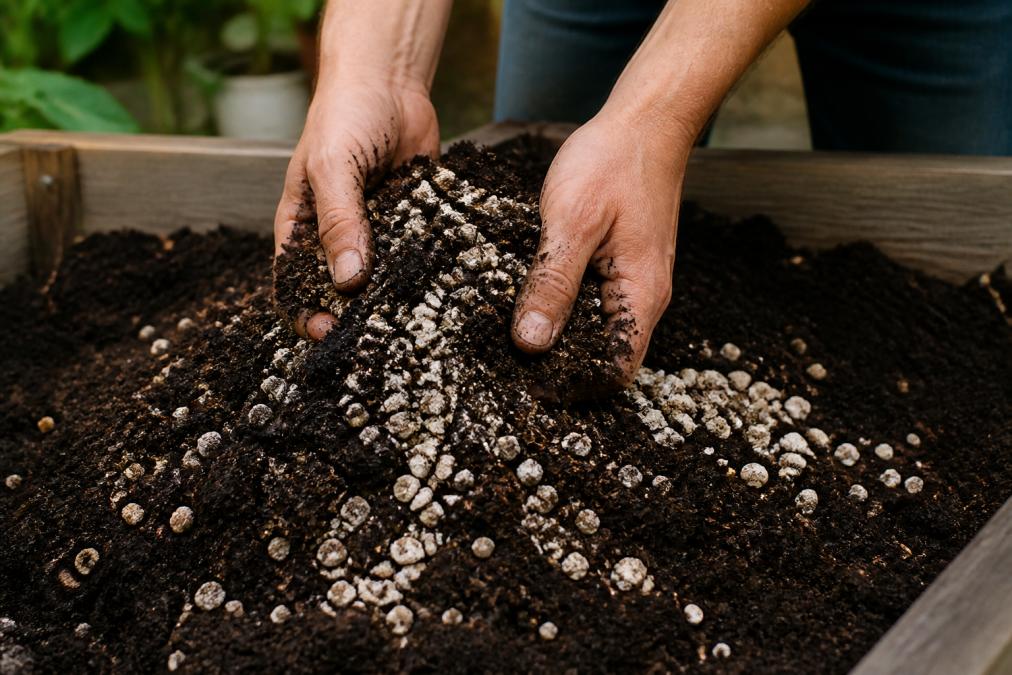
Zeolite's porous structure acts like a sponge, wedging between soil particles to prevent re-compaction and allow water and roots to penetrate more easily. Mix zeolite into the top 6-8 inches of soil; heavier clay requires more amendment than slightly compacted loam.
You'll notice better water infiltration within weeks, and by the second growing season, soil becomes noticeably lighter and easier to work with.
Benefits of Zeolite for Soil Structure and Plant Growth
Zeolite's crystalline structure contains millions of tiny chambers that capture and hold water, nutrients, and beneficial microbes, releasing them slowly through ion exchange, a process that mimics natural nutrient cycling.
Beyond drainage, zeolite improves aeration, stabilizes pH, and supports beneficial bacteria and fungi that break down organic matter and make nutrients available to plants.
Succulents and cacti benefit from zeolite's moisture-holding capacity combined with excellent drainage. Orchids thrive because it prevents root rot while maintaining consistent moisture. Vegetable gardens see improved yields as roots access nutrients more steadily, requiring less frequent but more effective watering.
OMRI Listed Minerals and Organic Certification Standards
OMRI (Organic Materials Review Institute) listing is the gold standard for organic gardening products, meaning the mineral has been reviewed and approved for use in organic production with no synthetic additives or chemical processing.
Look for OMRI listed products when buying organic mineral soil amendments online. This certification guarantees strict standards for purity and processing, no synthetic coatings, chemical treatments, or fillers.
Arden Line's OMRI listed zeolite is sourced from volcanic deposits and processed in the United States without synthetic additives, ensuring sustainable sourcing and processing practices that align with organic principles.
Soil Testing and Diagnosis Before Choosing Amendments
Before investing in organic mineral soil amendments, get a professional soil test to reveal pH, nutrient levels, organic matter percentage, soil texture, and cation exchange capacity (CEC), data you need to choose amendments strategically.
How to Get Your Soil Tested
Your local cooperative extension office offers soil testing at low cost ($15-$40 per sample) using standardized methods and providing region-specific recommendations. Contact your county extension directly for sample bags and instructions.
Take soil from at least 5-6 locations in the garden bed, mix together, and send one cup. Avoid sampling right after rain or fertilizer application; wait at least a week for stable readings.
Reading Your Test Results and Matching Amendments
A soil test report typically shows:
-
pH: Most vegetables and ornamentals prefer 6.0-7.0 (Why soil pH matters, and how to manage it in your garden). Agricultural lime raises acidic pH; sulfur lowers alkaline pH. Zeolite stabilizes pH once corrected but doesn't directly fix it.
-
Organic Matter: Below 3% is low; 5%+ is excellent. Low organic matter means compaction and poor water retention, where zeolite excels. High organic matter means less mineral amendment is needed.
-
Soil Texture: Clay-heavy soils (>40% clay) benefit most from zeolite. Sandy soils (>70% sand) need organic matter more than minerals; compost is the priority.
-
Nutrient Levels: Shown as ppm. Rock phosphate addresses low phosphorus; dolomitic limestone provides calcium and magnesium. Zeolite doesn't add nutrients directly; it holds and releases nutrients already in the soil.
-
Cation Exchange Capacity (CEC): Measures soil's ability to hold nutrients. Low CEC (below 5) means nutrients leach away, zeolite's ion-exchange properties become especially valuable.
Common Diagnosis Scenarios
Zeolite Mineral Lava Rocks (Regular) →
Clay soil, pH 6.5, low organic matter: Mix zeolite (1-2 lbs per 100 sq ft) with compost (2-3 inches). Zeolite opens structure; compost feeds biology.
Sandy soil, pH 6.8, very low organic matter: Add 3-4 inches of compost and 0.5-1 lb zeolite per 100 sq ft. Compost is the priority; zeolite improves water retention.
pH below 5.5 and low calcium: Apply agricultural lime at your extension office's recommended rate, wait 4-6 weeks, then retest. Once pH stabilizes, add zeolite for structure.
High pH (above 7.5) and low iron or manganese: Sulfur lowers pH; chelated iron or manganese address micronutrient deficiency. Zeolite improves structure but won't solve nutrient lock-up.
Why This Matters
A $30 soil test prevents $100+ in unnecessary purchases and tells you exactly how much amendment to apply. Most gardeners overestimate; test results let you start conservatively and adjust based on actual conditions.
Application Rates and Best Practices for Mineral Amendments
Application rate is commonly misunderstood. Too little won't improve soil structure; too much is wasteful. The correct rate depends on soil type, amendment depth, the specific mineral, and your soil test results.
Calculating Application Rates for Zeolite
Zeolite rates are typically expressed in pounds per 100 square feet or as a percentage of soil volume. Here's how to translate that into what you actually need:
For garden beds (in-ground):
- Clay soil with compaction: 1.5-2.5 lbs per 100 sq ft, worked into the top 6-8 inches. This is the standard starting rate for heavy clay. If your soil test shows CEC below 10 and clay content above 50%, use the higher end (2.5 lbs).
- Loamy soil with moderate compaction: 1-1.5 lbs per 100 sq ft. Loam is already partially structured, so less amendment is needed.
- Sandy soil: 0.5-1 lb per 100 sq ft. Sandy soil doesn't compact, but zeolite still improves water retention. Lower rates are sufficient.
Example calculation: A 10 ft × 20 ft garden bed = 200 sq ft.
For containers and potting mixes:
- Standard potting mix amendment: 10-15% zeolite by volume. For a 40-quart bag of potting soil, this means 4-6 quarts of zeolite mixed in.
- Succulent/cactus mix: 20-25% zeolite by volume. These plants need excellent drainage; higher zeolite percentage prevents root rot.
- Orchid mix: 15-20% zeolite by volume, combined with bark or sphagnum moss. Zeolite holds moisture while the bark and moss provide aeration.
For raised beds:
- New raised bed (no existing soil): Mix zeolite at 10-15% by volume into your soil blend. For a 4 ft × 8 ft × 12 in. bed (32 cubic feet), calculate 10% of 32 = 3.2 cubic feet of zeolite, or roughly 8-10 bags (assuming 40-lb bags).
- Amending existing raised bed soil: 1-2 inches of zeolite mixed into the top 6-8 inches of existing soil, equivalent to 1-1.5 lbs per 100 sq ft.
Adjusting Rates Based on Soil Test Results
Application Timing and Methods
Safety and Handling
Zeolite is non-toxic to plants, animals, and humans. However, avoid inhaling dust during application:
- Dampen the zeolite slightly (spray with a mister) before spreading to minimize airborne particles.
- Wear a dust mask if applying large quantities in a confined space or on a windy day.
- Once incorporated into soil, zeolite poses no inhalation risk.
Avoiding Over-Amendment
Sustainability and Long-Term Soil Health Investment
Organic mineral soil amendments represent a long-term investment in soil health that pays dividends year after year. Unlike synthetic fertilizers that deplete over a single season, minerals like zeolite persist in soil for years, continuing to improve structure and nutrient cycling. This makes them one of the most sustainable approaches to garden improvement.
| Mineral Amendment | Best For | Key Benefit | Sustainability |
|---|---|---|---|
| Zeolite | Clay soil, containers, aeration | Improves drainage and nutrient retention | Long-lasting, naturally sourced |
| Compost | Organic matter, nutrient boost | Feeds soil biology and structure | Renewable, can be homemade |
| Rock phosphate | Phosphorus deficiency | Slow-release phosphorus | Mined mineral, long-lasting |
| Agricultural lime | Low pH correction | Raises pH, adds calcium | Mined mineral, widely available |
Frequently Asked Questions
What are the best organic mineral soil amendments for clay soil?
Zeolite is one of the most effective organic mineral amendments for clay soil. Its porous structure improves drainage and aeration while retaining nutrients. The best choice depends on your soil test results and specific plant needs. Arden Line's zeolite products are OMRI listed and improve soil tilth without chemicals.
How often should you apply mineral soil amendments to your garden?
Application frequency depends on the amendment and your soil type. Zeolite is long-lasting and does not break down quickly, so one application can improve soil structure for years. For annual gardens, work amendments into the soil at the start of the growing season. Always follow soil test recommendations and product instructions for application rates to avoid over-application.
Are mineral soil amendments safe for organic gardening?
Yes, when you choose OMRI listed products. OMRI certification confirms that amendments meet organic production standards and contain no synthetic chemicals or artificial additives. Arden Line's zeolite is OMRI listed, making it safe for certified organic gardens and vegetable production. Natural volcanic minerals are approved by organic certifiers because they work with soil biology rather than replacing it, supporting microbial activity and nutrient cycling.
How do volcanic minerals like zeolite improve soil health?
Zeolite's porous structure acts like a sponge, holding water and positively charged nutrients such as potassium and ammonium in the root zone while releasing them slowly. This reduces nutrient leaching, improves cation exchange capacity, and supports stronger root development. Zeolite also improves soil aeration by reducing compaction, which promotes beneficial soil biology and mycorrhizae growth. Over time, this builds soil structure and increases organic matter retention.


Leave a comment
This site is protected by hCaptcha and the hCaptcha Privacy Policy and Terms of Service apply.