

Table of Contents
- What Is Zeolite and Why It Matters for Chicken Coops
- How to Stop Chicken Coop Ammonia Smell with Zeolite
- Managing Moisture in Chicken Coops
- Minimizing Zeolite Dust Tracking
- Step-by-Step Application Guide
- Safety and Respiratory Health Considerations
- Cost-Benefit Analysis and Maintenance Timeline
- Frequently Asked Questions
Last Updated: September 18, 2026
What Is Zeolite and Why It Matters for Chicken Coops
Zeolite is a naturally porous mineral that traps ammonia, moisture, and odors in chicken coops instead of masking them with fragrance. This volcanic mineral works at the molecular level, pulling harmful gases and excess water out of your bedding and coop air. The result is a cleaner, drier environment for your flock.
The mineral's structure is what makes it special. Zeolite contains tiny channels and pockets, called a porous structure, that act like a sponge for ammonia gas and moisture. When chickens produce waste, ammonia builds up quickly in enclosed spaces. Traditional bedding absorbs some moisture but doesn't neutralize the gas. Zeolite does both.
A small coop with just eight birds benefits as much as a larger operation. The mineral adapts to your flock size and bedding style.
At Arden Line, we source pure volcanic zeolite and mill it finely to prevent excessive dust while maintaining the absorbent properties your coop needs. Our products are designed for small-scale operations where every square foot counts.

How to Stop Chicken Coop Ammonia Smell with Zeolite
Ammonia smell is the biggest complaint among backyard chicken keepers. It builds fast. Within days of adding fresh bedding, the smell returns. This happens because chickens produce waste constantly, and that waste releases ammonia gas into the air.
Zeolite stops this cycle. The mineral's cation exchange capacity, its ability to swap positive ions, allows it to bind ammonia molecules and hold them until you remove the bedding. You're not covering the smell. You're eliminating it.
Here's what happens when you apply zeolite:
- Ammonia gas is trapped in the mineral's pores
- Moisture is absorbed before it feeds bacterial growth
- The coop air stays fresher between cleanings
- Your chickens breathe cleaner air, supporting respiratory health
The coop smells noticeably better. Your birds seem more comfortable.
The Arden Line Chicken Coop Deodorizer uses 100% natural zeolite with no added fragrances or chemicals. You're adding a mineral amendment, not a scent mask. This matters for your birds' health and your peace of mind.

Managing Moisture in Chicken Coops
Moisture is ammonia's best friend. Wet bedding creates the perfect environment for ammonia gas to form and linger. Your coop becomes humid, damp, and smelly fast.
Zeolite's moisture-wicking properties solve this problem. The mineral pulls water away from bedding, keeping it dry longer. Dry bedding means less ammonia production and longer intervals between full cleanings.
Moisture control also prevents mold and parasites. Damp bedding attracts pests and fungal growth. Both harm your flock's health. By keeping bedding dry, you reduce these risks naturally.
Here's how zeolite improves moisture management:
- Absorbs excess water from chicken waste and droppings
- Reduces fecal moisture that promotes ammonia formation
- Keeps nesting boxes dry, protecting eggs and broody hens
- Lowers overall coop humidity
The micro-porosity of zeolite, its tiny internal structure, gives it exceptional absorbent capacity.
Minimizing Zeolite Dust Tracking
This is the question every chicken keeper asks: Will zeolite dust end up everywhere?
The answer depends on particle size. Finely milled zeolite creates less dust than coarser mineral products. When you choose a product specifically milled for poultry use, dust tracking is minimal.
Dust tracking happens when:
- You apply zeolite too heavily in one spot
- Chickens kick bedding around the coop
- Wind carries particles outside on your shoes or clothes
- You use an overly coarse product
To minimize dust:
- Apply zeolite evenly across bedding instead of in piles
- Use finely milled zeolite designed for coop use
- Sprinkle lightly and mix into the top layer of bedding
- Avoid applying on windy days if your coop is outdoors
- Wear a basic dust mask when applying to avoid inhaling particles
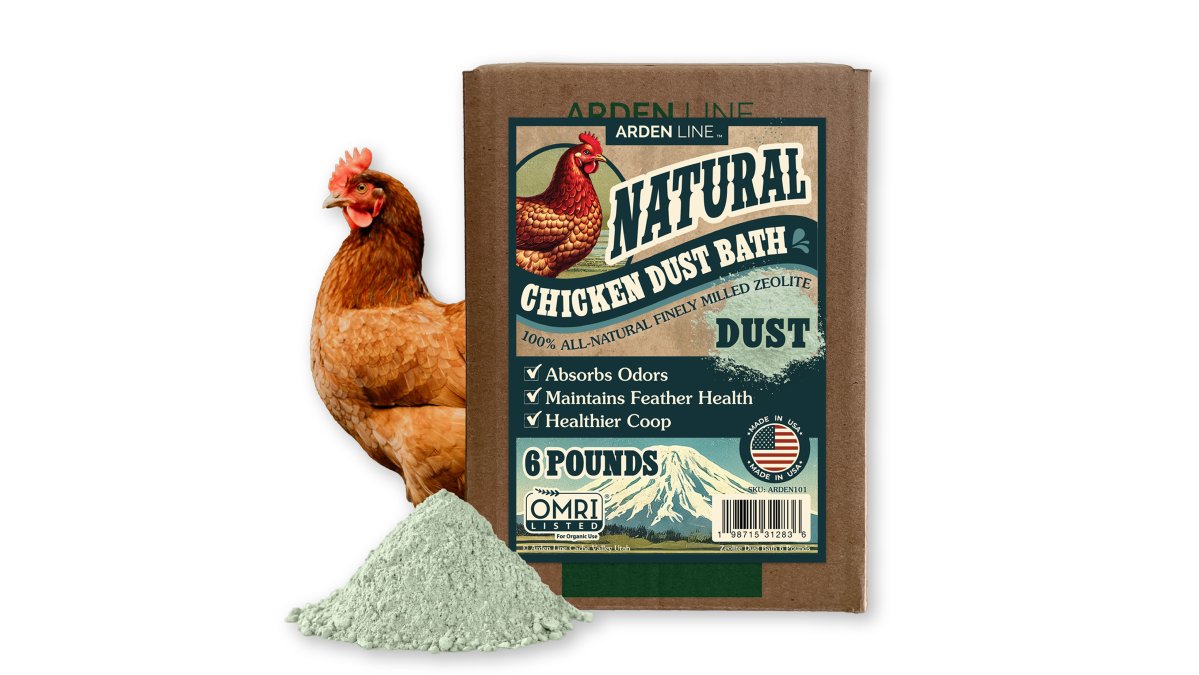
The Arden Line Chicken Dust Bath uses finely milled zeolite that stays where you put it. It doesn't create clouds of dust when you sprinkle it. This keeps zeolite dust tracking to a minimum.
Step-by-Step Application Guide
Total Time: 10-15 minutes per application
Frequency: Every 2-3 weeks or as needed based on moisture and odor
Applying zeolite correctly ensures you get the best results. Here's the process:
Step 1: Prepare Your Coop [Time: 2 minutes]
Remove large waste clumps and soiled bedding. You don't need to do a full cleanout. Just clear the worst spots so zeolite can work with clean bedding underneath.
Step 2: Sprinkle Zeolite Evenly [Time: 5 minutes]
Open your zeolite container and sprinkle it lightly across the coop floor. Cover the main bedding area, poop boards, and nesting boxes. Use about 1-2 cups per 100 square feet of coop space, depending on your flock size.
Step 3: Mix Into Bedding [Time: 3 minutes]
Use a rake or your hands to gently mix zeolite into the top layer of bedding. This distributes it evenly and prevents clumping. Don't bury it too deep. The mineral works best when it's in contact with waste and moisture.
Step 4: Focus on High-Traffic Areas [Time: 2 minutes]
Add extra zeolite to poop boards and under roosting bars where waste concentrates. These spots need more absorbent power than open coop areas.
Step 5: Monitor and Reapply [Ongoing]
Check your coop every few days. When bedding looks wet or smells stronger, it's time to reapply. Most keepers reapply every 2-3 weeks depending on flock size and coop ventilation.
| Application Step | Time Required | Frequency | Best Practice |
|---|---|---|---|
| Remove soiled bedding | 2 minutes | Every 2-3 weeks | Focus on poop boards |
| Sprinkle zeolite | 5 minutes | Every 2-3 weeks | Even coverage, 1-2 cups per 100 sq ft |
| Mix into bedding | 3 minutes | Every 2-3 weeks | Top layer only, don't bury |
| Target high-traffic zones | 2 minutes | Every 2-3 weeks | Under roosts and nesting boxes |
| Monitor moisture | Daily | Ongoing | Reapply when bedding feels damp |
Safety and Respiratory Health Considerations
Zeolite is safe for chickens when used correctly, but particle size is the critical variable that separates safe products from respiratory hazards.
Particle Size and Respiratory Risk
Application Safety for You
When you apply zeolite:
- Wear a basic dust mask (N95 or equivalent) to avoid inhaling particles yourself
- Apply on calm days to prevent wind from carrying dust outside the coop
- Don't create clouds of dust when sprinkling; use a gentle hand or a shaker container
- Apply to bedding, not directly to birds
- Avoid applying in enclosed spaces without ventilation
Safety for Your Chickens
Chickens naturally dust bathe in zeolite, and this is safe when the product is properly milled.
Ammonia gas is the real respiratory threat in chicken coops.
Cost-Benefit Analysis and Maintenance Timeline
Zeolite costs more per pound than basic bedding amendments.
Calculating Long-Term Savings
A typical small backyard flock (8-12 birds) requires one zeolite application every 2-3 weeks. One container of zeolite provides 3-4 applications, meaning one purchase covers roughly 6-12 weeks of maintenance.
Compare this to traditional bedding replacement:
- Without zeolite: Full bedding change every 7-10 days (high labor, frequent material cost)
- With zeolite: Full bedding change every 3-4 weeks (reduced labor, lower material cost)
Realistic Maintenance Timeline
- Weeks 1-3: Initial zeolite application; monitor moisture and odor daily
- Week 4: Assess bedding condition; reapply if moisture returns or odor increases
- Weeks 5-8: Continue 2-3 week application cycle; remove large waste clumps between applications
- Week 9-12: Full bedding change (quarterly deep clean); restart zeolite cycle
- Repeat quarterly: Full cleanout every 12 weeks; zeolite applications every 2-3 weeks in between
What to Do with Used Zeolite
- Garden and landscape use: Spread it directly on garden beds, vegetable gardens, or around ornamental plants.
- Composting: Add used zeolite to compost piles. It won't break down, but it won't interfere with decomposition either. The mineral will remain in your finished compost, improving soil structure and water retention.
- Pasture improvement: If you rotate your flock to fresh ground, spread used zeolite on the old pasture area.
- Disposal: If you can't reuse it, used zeolite is non-toxic and can be disposed of in regular yard waste or landfill. It poses no environmental risk.
Flock Size Adjustments
Scaling zeolite use to your flock is straightforward:
- Small flock (4-6 birds): 1 application every 3-4 weeks; one container lasts 3-4 months
- Medium flock (8-12 birds): 1 application every 2-3 weeks; one container lasts 6-8 weeks
- Large flock (15+ birds): 1 application every 10-14 days; one container lasts 4-6 weeks
Frequently Asked Questions
Is zeolite safe for chickens to inhale?
Yes, when applied correctly. The key is using particle sizes designed for poultry use and avoiding excessive dust clouds during application.
How do I apply zeolite in a chicken coop to reduce dust tracking?
Apply zeolite directly to bedding, poop boards, and nesting boxes at a rate of 1-2 pounds per 100 square feet. Reapply after cleaning or when odor returns. For dust bath use, fill a dedicated container with finely milled zeolite.
Does zeolite effectively neutralize ammonia in chicken coops?
Yes. Zeolite's porous mineral structure, clinoptilolite, works through cation exchange capacity to trap ammonia gas and moisture at the source rather than masking odors. This keeps bedding drier and reduces the chemical compounds that create coop smell, supporting better respiratory comfort for your flock.
How often should I refresh zeolite in my chicken coop?
Refresh zeolite every 2-4 weeks depending on flock size, coop ventilation, and bedding type. Smaller coops with higher bird density may need more frequent application. Monitor bedding moisture and ammonia smell as your guide, reapply when odor returns or bedding feels damp.


Leave a comment
This site is protected by hCaptcha and the hCaptcha Privacy Policy and Terms of Service apply.