
Table of Contents
- What an Organic Soil Conditioner Does for Backyard Gardens
- How to Improve Drainage in Clay Garden Soil
- Soil Conditioner vs. Compost: What Each One Actually Does
- Benefits of Zeolite for Soil Health in Raised Beds and Containers
- Soil Testing Before You Apply Anything
- Vegetable-Specific Amendment Schedules
- DIY vs. Store-Bought Amendments: Cost and Environmental Trade-Offs
- Conclusion
- Frequently Asked Questions
Last Updated: September 21, 2026
What an Organic Soil Conditioner Does for Backyard Gardens
An organic soil conditioner is a natural material worked into soil to improve its physical structure, water movement, and nutrient-holding capacity rather than simply feeding plants. This guide from Arden Line covers how conditioners differ from fertilizers, how to diagnose clay and compaction problems, and how to match amendments to specific vegetables.
How to Improve Drainage in Clay Garden Soil
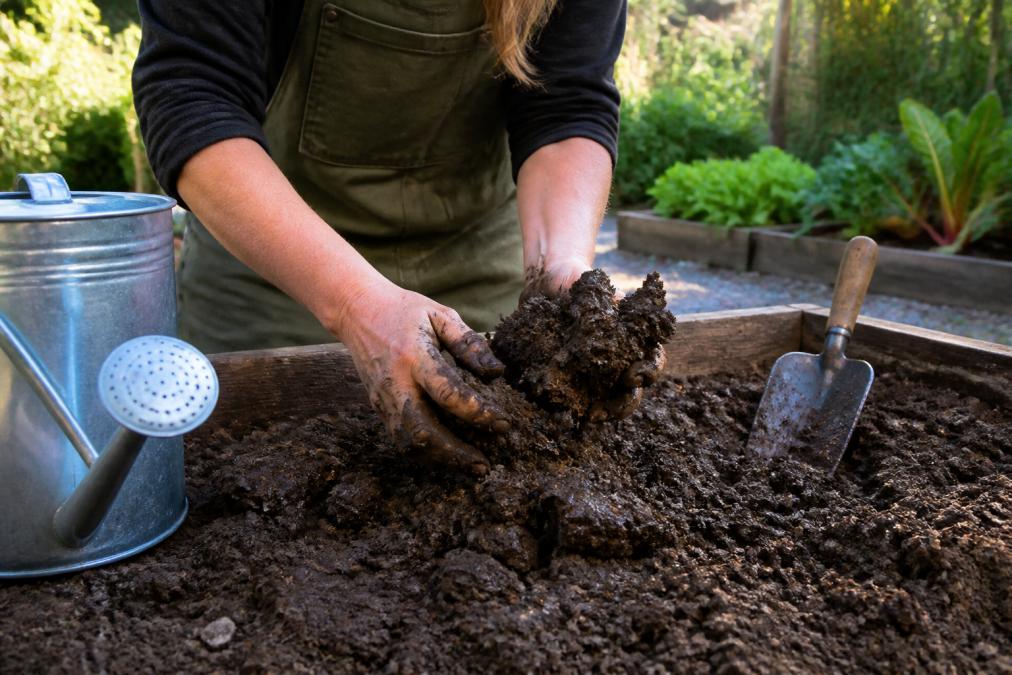
The fastest fix for clay drainage is adding coarse, porous material that creates permanent air and water channels. Mix it into the top 15-20 cm (6-8 inches) rather than laying it on the surface, where it does almost nothing.
Clay vs. Compaction: Which Problem Do You Have?
They look identical from above but need different fixes. Clay is a soil texture you're born with; compaction is a condition you created, usually by walking or driving on wet beds.
Here's a quick way to tell them apart:
- Clay: sticky when wet, rock-hard when dry, forms a ribbon when squeezed between your fingers
- Compaction: a hard pan 10-20 cm down; a screwdriver pushed into moist soil stops dead
- Both: poor drainage plus stunted roots, often in the same bed
Where Zeolite Fits in a Clay Soil Fix
Zeolite is a naturally porous volcanic mineral that holds water and positively charged nutrients in the root zone, then releases them slowly. Unlike compost, it does not break down, so a single application keeps working season after season.
Soil Conditioner vs. Compost: What Each One Actually Does
Compost feeds soil life and adds organic matter; a mineral conditioner like zeolite changes structure and holds nutrients. The two do different jobs, and most backyard gardens benefit from both.
| Feature | Compost | Zeolite Conditioner |
|---|---|---|
| What it does | Feeds soil life | Holds water and nutrients |
| Breaks down? | Yes, yearly | No, lasts for years |
| Improves microbes? | Strongly | Indirectly |
| Best paired with | Mineral amendments | Compost and mulch |
Benefits of Zeolite for Soil Health in Raised Beds and Containers
Raised beds and containers drain fast and dry out quickly, which is exactly where a mineral conditioner earns its keep. Zeolite reduces watering frequency and keeps nutrients where roots can reach them.
How Zeolite Holds Water and Nutrients
Zeolite's internal cage-like structure traps water molecules and positively charged ions such as ammonium and potassium. Plant roots and microbes pull them back out as needed, so feeding becomes steadier instead of feast-or-famine.
Soil Testing Before You Apply Anything
Test before you amend. A basic soil test tells you pH, nutrient levels, and organic matter, which prevents the most expensive mistake in gardening: fixing a problem you don't have. Most guides skip this step and jump straight to product lists, that's why so many backyard beds get dosed with lime, sulfur, or compost they never needed.
What a Standard Test Actually Measures
A typical lab panel reports five numbers you'll use to pick a conditioner:
- pH, controls whether nutrients are chemically available at all. Most vegetables grow best between 6.0 and 7.0.
- Buffer pH, tells you how much lime or sulfur is needed to shift pH, not just the current reading.
- Organic matter (OM), the single best predictor of structure. Below 2% and your soil will crust and compact; 4-6% is a healthy target for vegetable beds.
- Macronutrients (P, K, Ca, Mg), reported in parts per million (ppm) or pounds per acre, with a rating of low, medium, or high.
- Cation exchange capacity (CEC), the soil's nutrient-holding capacity. Sandy soils often run under 5; clay and high-organic soils can exceed 25. This number tells you how often you'll need to feed.
How to Pull a Representative Sample
A test is only as good as the sample. A common pattern is to sample too shallow or from one spot, which produces a reading that doesn't match the bed.
Zeolite Mineral Lava Rocks (Regular) →
- Use a clean trowel or soil probe, not a galvanized tool, which can contaminate the sample with zinc.
- Sample 6-8 inches deep for vegetable beds. For lawns, 3-4 inches is standard.
- Take 8-15 cores in a zigzag across the bed, then mix them in a clean plastic bucket.
- Air-dry the mixed sample on newspaper, then bag about 1-2 cups.
- Label it with the bed name and date, you'll want to compare year over year.
Where to Send It
Most state university extension services run soil testing labs, and many county offices sell kits with a submission form. The USDA's extension network can point you to the right lab for your area. Private labs also offer tests, often with faster turnaround and more detailed micronutrient panels. Typical turnaround is 1-2 weeks.
Reading the Results Before You Buy Anything
Match the diagnosis to the fix:
- Low OM, poor structure → compost, leaf mold, or a mineral conditioner like zeolite to build lasting pore space
- High pH (above 7.5) → avoid amendments that push pH higher; zeolite runs around 8.5, so it's fine in acidic soil but worth knowing if your bed already runs alkaline
- Low CEC, sandy soil → organic matter first, then a slow-release mineral to hold nutrients between waterings
- Compacted layer, adequate OM → the fix is mechanical (broadfork, aeration), not more compost
Vegetable-Specific Amendment Schedules
Different vegetables want different soil conditions, so one blanket amendment plan rarely fits a whole garden. Match your conditioner and compost blend to what you're actually growing, and to when that crop actually needs it. Below is a season-long calendar you can adapt to your beds.
Early Spring (4-6 Weeks Before Last Frost)
This is when the heavy structural work happens. Soil life needs time to settle before roots arrive.
- Tomatoes and peppers: work 2-3 inches of finished compost into the top 6-8 inches, plus a coarse mineral amendment like zeolite at roughly 10-15% by volume in raised beds. Both crops feed hard and hate wet feet.
- Root crops (carrots, beets, parsnips): light compost only, about 1 inch, worked into the top 4-6 inches. Too much fresh organic matter causes forked and hairy roots.
- Leafy greens (lettuce, spinach, kale): 1-2 inches of compost plus a moisture-holding amendment in the top layer. Steady moisture matters more than fertility for these crops.
- Squash and cucumbers: rich compost with good drainage. If your clay is stubborn, mound-plant on top of amended soil rather than fighting the subsoil.
- Herbs (rosemary, thyme, oregano): lean, fast-draining mix. Skip heavy compost entirely; these plants resent rich, wet soil.
At Planting
- Tomatoes and peppers: a handful of compost in the planting hole; if using zeolite, mix a small amount into the backfill so it sits in the root zone.
- Leafy greens: sow directly into the amended top layer; no additional conditioner needed.
- Root crops: plant into settled, fine soil, no fresh amendment in the furrow.
Mid-Season (6-8 Weeks After Planting)
- Heavy feeders (tomatoes, peppers, squash): side-dress with compost or a diluted organic feed. A mineral conditioner applied at spring planting is still holding nutrients at this point.
- Leafy greens: succession-sow every 2-3 weeks for a continuous harvest; refresh the top inch of compost between sowings.
- Root crops: avoid disturbing the soil around developing roots.
Fall (After Harvest)
- All beds: top-dress with 1-2 inches of compost or leaf mold and let it sit over winter. Worms and microbes will work it in.
- Heavy clay beds: this is the best window to add a permanent mineral amendment. Freeze-thaw cycles help it integrate.
- Cover crops: where beds will sit empty, sow a cover crop like crimson clover or winter rye to protect structure and add organic matter.
Quick Reference
| Crop group | Compost | Mineral conditioner | Timing |
|---|---|---|---|
| Tomatoes, peppers | Heavy (2-3 in) | Yes, coarse grade | 4-6 weeks pre-plant |
| Root crops | Light (1 in) | No | 2-3 weeks pre-plant |
| Leafy greens | Medium (1-2 in) | Yes, fine grade | 2 weeks pre-plant |
| Squash, cucumbers | Heavy | Yes, coarse grade | 4 weeks pre-plant |
| Herbs | None or minimal | Yes, for drainage | At planting |
Work amendments in two to three weeks before planting so soil life has time to settle. Adjust quantities based on your soil test, a bed already at 5% organic matter needs less compost than one at 1.5%.
DIY vs. Store-Bought Amendments: Cost and Environmental Trade-Offs
Homemade compost is nearly free and keeps kitchen and yard waste out of landfills, but it takes space, time, and consistent turning. Bagged mineral amendments cost more upfront yet deliver predictable, consistent results with no curing time.
Conclusion
The hardest part of soil improvement isn't buying the right product; it's diagnosing the actual problem before you spend a dollar. Test first, then amend with materials that match your soil type and the vegetables you grow.
Frequently Asked Questions
Is zeolite a good organic soil conditioner for backyard gardens?
Zeolite is a naturally occurring mineral (clinoptilolite) that holds water and positively charged nutrients like potassium and ammonium in the root zone, then releases them slowly. It is OMRI Listed, which means it is approved for use in organic production. For backyard gardens, it improves drainage, aeration, and nutrient retention without adding chemicals or synthetic fillers. It works especially well in raised beds, containers, and clay-heavy soil where water pools or nutrients leach away quickly.
How often should I apply soil conditioner to a garden?
Compost and organic matter break down over time, so most gardeners reapply them once or twice a year, typically in spring and fall. Mineral amendments like zeolite do not decompose, so a single application can last for years. For clay soil, mix zeolite into the top 6 to 8 inches at planting time, then check drainage each season. If water still pools after rain, add more. A soil test every two to three years will tell you whether nutrient levels are holding steady.
What can I use instead of soil conditioner if I want to make my own?
Leaf mold, finished compost, worm castings, and aged manure all work as homemade soil conditioners. Leaf mold is free if you have trees and improves soil structure over time. Compost adds organic matter and beneficial microbes. Worm castings are nutrient-dense but produced in smaller quantities. For drainage specifically, mineral options like zeolite outperform DIY materials because they do not break down. A mix of compost for biology and zeolite for structure covers both needs in a backyard vegetable bed.
How do I know if my soil needs a conditioner or just more compost?
Start with a soil test through your state's cooperative extension service. If organic matter is below 3%, you need compost. If organic matter is adequate but water pools after rain or drains too fast, you need a structural amendment like zeolite. Compaction shows up as hard, dense soil that roots struggle to penetrate. Clay soil holds water tightly and cracks when dry. A conditioner fixes the physical structure; compost feeds the biology. Many gardens need both.

Leave a comment
This site is protected by hCaptcha and the hCaptcha Privacy Policy and Terms of Service apply.