
Table of Contents
- What Makes a Soil Conditioner Work for Vegetable Gardens
- How to Improve Drainage in Clay Garden Soil
- Organic Soil Amendments for Vegetables: Your Options
- Benefits of Zeolite for Garden Soil
- Soil Testing Before You Amend
- Application Schedule for Vegetable Gardens
- Natural vs. Synthetic: What Matters for Your Garden
- Frequently Asked Questions
Last Updated: September 20, 2026
What Makes a Soil Conditioner Work for Vegetable Gardens
A soil conditioner is any material that improves soil structure, water retention, or nutrient availability to help plants grow stronger. The best natural soil conditioners for vegetables work by holding moisture and nutrients in the root zone while improving drainage and aeration at the same time.
Soil conditioner materials work in three main ways:
- Improve soil structure by breaking up compaction and creating space for air
- Hold nutrients and water in forms plants can use over time
- Support beneficial microbes that help plants absorb nutrients naturally
How to Improve Drainage in Clay Garden Soil
Clay soil drains poorly because particles pack tightly together, leaving no room for air or water movement. The fix is adding materials that create space between those particles.
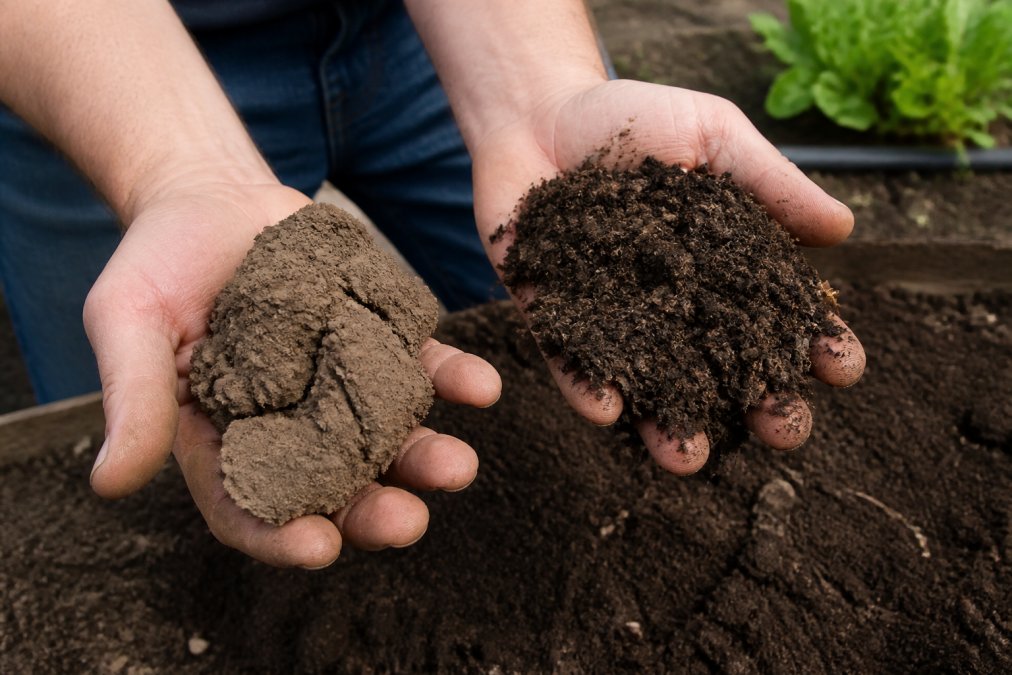
The best approach combines two actions:
- Add organic matter to break up clay structure
- Mix in a mineral amendment that stays stable long-term
Organic Soil Amendments for Vegetables: Your Options
Compost and Aged Manure
Compost is partially decomposed plant material. Aged manure is animal waste that has sat for at least six months. Both add organic matter and beneficial microbes to soil.
Pros:
- Inexpensive if you make your own
- Adds visible organic matter
- Supports beneficial soil microbes
Cons:
- Breaks down within 1-2 years
- Requires annual reapplication
- May contain weed seeds if not fully composted
Coco Coir and Peat Moss
Coco coir is shredded coconut husk. Peat moss is decomposed plant material from wetlands. Both hold water and improve soil structure.
Pros:
- Excellent water retention
- Lightweight and easy to work with
- Coco coir is renewable
Cons:
- Breaks down over 2-3 years
- Needs regular replacement
- Peat moss harms wetlands
Worm Castings and Humates
Worm castings are worm manure, the processed waste from composting worms. Humates are concentrated organic compounds from ancient plant material. Both are nutrient-rich and support soil biology.
Pros:
- High nutrient density
- Support beneficial soil organisms
- Work well with other amendments
Cons:
- More expensive per pound
- Don't improve structure as much as compost
- Need to be mixed into soil to work well
Biochar and Volcanic Minerals
Biochar is charred plant material that holds water and nutrients for long periods. Volcanic minerals like zeolite are naturally porous rocks that trap nutrients and moisture in the root zone.
Pros:
- Last for years without replacement
- Improve both drainage and water retention
- Support beneficial soil microbes
- Stable and predictable performance
Cons:
- Higher upfront cost
- Need proper application rates
- Take time to show full benefits
Benefits of Zeolite for Garden Soil
Zeolite is a volcanic mineral with a naturally porous structure. Each particle acts like a tiny sponge, holding water and positively charged nutrients such as potassium and ammonium.
Soil Testing Before You Amend
Many gardeners add amendments without knowing what their soil actually needs. A soil test reveals your soil's pH, nutrient levels, texture, and organic matter content, information that directly guides which amendments will actually solve your specific problem.
What a Soil Test Reveals
A standard soil test measures:
- pH level (acidity or alkalinity on a 0-14 scale): Most vegetables prefer 6.0-7.0 pH. If your soil is below 6.0, it's too acidic and may lock up nutrients like phosphorus and potassium. Above 7.5, it becomes alkaline and can make iron, manganese, and zinc unavailable to plants.
- Nutrient content (nitrogen, phosphorus, potassium, and micronutrients): The test reports these in parts per million (ppm). Low nitrogen means you need more compost or aged manure. Low phosphorus signals the need for bone meal or rock phosphate. Low potassium suggests adding wood ash or greensand.
- Soil texture (percentage of clay, silt, and sand): Clay-heavy soil (>40% clay) drains poorly and needs mineral amendments like zeolite or biochar. Sandy soil (<20% clay) drains too fast and needs water-holding amendments like coco coir or compost.
- Organic matter percentage: Most tests report this as a percentage by weight. Vegetable gardens perform best with 5-10% organic matter. Below 3%, you need to add 2-3 inches of compost annually. Above 10%, your soil is already rich and may need less amendment.
- Cation exchange capacity (CEC): This measures how well soil holds nutrients. High-CEC soils (clay and silt-based) hold nutrients longer; low-CEC soils (sandy) release them quickly. This affects how often you need to reapply amendments.
Interpreting Results to Choose Amendments
If pH is below 6.0 (acidic): Add agricultural lime (calcium carbonate) at rates recommended by your extension office, typically 1-2 tons per acre for home gardens. Compost and aged manure are neutral choices.
How to Collect and Submit a Sample
Take samples from at least five spots in your garden, mix them together, and send 1-2 cups to your extension office. Avoid sampling right after rain or fertilizer application. Most extension offices return results within 7-10 days with specific amendment recommendations for your crops.
Application Schedule for Vegetable Gardens
The best natural soil conditioners for vegetables need a schedule tailored to your crops and soil type. Different vegetables have different root depths, nutrient demands, and growing timelines, so amendment timing and rates should match what you're actually growing.
Spring Application (2-4 Weeks Before Planting)
Spring is when you build the foundation for the season. Work amendments into the top 6-8 inches of soil where most vegetable roots will grow.
For all gardens:
- Add 1-2 inches of finished compost or aged manure and work it in thoroughly. This provides immediate organic matter and microbial activity.
- If your soil test showed pH below 6.0, add agricultural lime at extension-recommended rates and work it in. Lime needs 4-6 weeks to raise pH, so apply in early spring.
- If your soil is clay-heavy (>40% clay) and drainage is poor, add zeolite at 10-20% by volume mixed with compost. For a 100-square-foot bed, this means 1-2 inches of zeolite blended with 1-2 inches of compost, worked down together.
For heavy feeders (tomatoes, peppers, squash, cabbage):
Zeolite Mineral Lava Rocks (Regular) →
- Add an extra 1/2 inch of aged manure or 1/4 inch of worm castings mixed into the top 4 inches. These crops extract large amounts of nitrogen and benefit from nutrient-rich amendments at planting time.
For light feeders (leafy greens, root vegetables, beans):
- Standard compost application is sufficient. These crops don't deplete soil as heavily and are sensitive to excess nitrogen, which can delay fruiting in beans or cause leafy greens to bolt.
Early Summer (At Planting or First True Leaves)
Once plants are established, side-dress with amendments to support active growth without disturbing roots.
For all crops:
- Apply 1/4 inch of worm castings or humates as a side dressing around plants, 2-3 inches away from stems. Water in well. This feeds the soil biology that makes nutrients available throughout the growing season.
- Do not dig or turn soil around growing plants; side-dress only.
For heavy feeders (tomatoes, peppers, squash):
- At first flowering, apply another 1/4 inch of worm castings or aged manure. Fruiting crops need sustained nitrogen and potassium. Repeat every 3-4 weeks through mid-summer.
For leafy greens (lettuce, spinach, kale):
- Apply a light side dressing of compost (1/4 inch) every 2-3 weeks if harvesting continuously. Leafy greens have shallow roots and benefit from frequent, light applications rather than heavy single doses.
Mid-Summer (Maintenance)
During peak heat and growth, focus on water retention and microbial support rather than adding new nutrients.
For all gardens:
- Mulch around plants with 1-2 inches of compost or shredded leaves. This keeps soil cooler, retains moisture, and feeds soil biology as it breaks down.
- If you added zeolite or biochar in spring, they are now working to hold water and nutrients. No additional mineral amendments are needed mid-season.
Fall (After First Harvest or Frost)
Fall is when you rebuild soil for next year. Add amendments that will settle and integrate over winter.
For all gardens:
- Add 1-2 inches of finished compost or aged manure. Fall-applied amendments have 4-6 months to integrate before spring planting.
- If you're improving long-term soil structure, add biochar at 5-10% by volume mixed with compost. Biochar works best when incorporated in fall; it takes 2-3 months to fully activate.
- Do not add lime in fall unless your soil test is more than 6 months old. Fall lime application may over-correct by spring.
For heavy-feeding crops (if replanting in fall):
- Add 1/2 inch of aged manure or worm castings before planting fall crops like broccoli, kale, or spinach. These crops mature in cool weather and benefit from nutrient-rich soil.
Winter (Dormancy and Planning)
Winter is planning and testing time, not application time.
- Let fall-applied amendments settle. Do not dig or disturb soil.
- Send a soil sample to your extension office if you haven't tested in 2-3 years. Results will guide spring applications.
- Calculate amendment needs for spring based on last season's performance. If drainage improved, you may need less zeolite. If organic matter dropped below 5%, plan for heavier compost application.
Multi-Year Amendment Schedule
Beyond the annual cycle, plan longer-term amendments:
Every year:
- Add 1-2 inches of compost or aged manure (organic matter breaks down and must be replenished)
Every 2-3 years:
- Reapply mineral amendments like zeolite if drainage declines or if your soil test shows CEC dropping
- Test soil to catch pH drift or nutrient depletion early
Every 3-5 years:
- Add biochar at 5-10% by volume if building long-term structure. Biochar lasts for years, so one application per 5 years maintains benefits.
Adjusting for Soil Type
Your soil texture changes how often you amend:
Clay soil: Needs mineral amendments (zeolite, biochar) every 2-3 years to maintain drainage. Organic matter breaks down faster in clay due to microbial activity, so add compost annually.
Natural vs. Synthetic: What Matters for Your Garden
Synthetic soil amendments are manufactured chemicals designed to improve specific soil properties. Natural amendments come from organic or mineral sources.
Cooperative Extension soil testing guidelines
USDA soil health resources
Soil Science Society of America soil management guide
Frequently Asked Questions
How do I know if my vegetable garden soil needs a conditioner?
Signs include slow water drainage, compacted soil that resists digging, poor vegetable growth despite adequate sunlight, and crusting on the soil surface. Clay soils drain poorly; sandy soils dry out too quickly. A simple soil test, available through your local cooperative extension, reveals texture, pH, nutrient levels, and organic matter content. This diagnostic step prevents wasting money on amendments your soil doesn't need.
What's the difference between soil conditioners and fertilizers?
Soil conditioners improve soil structure, drainage, aeration, and water retention, they don't directly feed plants. Fertilizers supply nitrogen, phosphorus, and potassium that plants consume. Most vegetables benefit from both. Natural soil conditioners like compost and zeolite improve nutrient availability by increasing cation exchange capacity, meaning your plants access nutrients more efficiently. This reduces nutrient leaching and extends the life of applied fertilizers.
How often should I apply soil conditioners to my vegetable garden?
Most organic conditioners like compost break down over 1-2 seasons, so reapply annually in spring or fall. Mineral amendments like zeolite last much longer before needing replacement. Work 2-4 inches of compost into the top 6-8 inches of soil each season. For zeolite, apply once at planting and reapply every 2-3 years. Frequency depends on your soil type, rainfall, and how intensively you garden.
Can I mix different soil conditioners together?
Yes. Combining amendments often produces better results than using one alone. For example, mixing compost (organic matter), zeolite (mineral aeration and nutrient retention), and worm castings (beneficial microbes and slow-release nutrients) creates a well-rounded soil biology and structure. Avoid over-amending, excess minerals or organic matter can lock up nutrients or create imbalance. Start with a soil test to guide your blend.

Leave a comment
This site is protected by hCaptcha and the hCaptcha Privacy Policy and Terms of Service apply.