

Table of Contents
- What a Natural Volcanic Mineral Coop Additive Actually Does
- Zeolite for Chicken Coops: What to Check Before You Buy
- Natural Coop Odor Control: How to Apply It for Real Results
- Chicken Coop Moisture Absorber: Matching Pack Size to Flock Size
- Volcanic Rock Dust for Soil: The Same Mineral, a Different Job
- What to Compare When Buying a Coop Additive
- Conclusion
- Frequently Asked Questions
Last Updated: October 12, 2026
What a Natural Volcanic Mineral Coop Additive Actually Does
A natural volcanic mineral coop additive is a mined, mineral-based material, most often zeolite, that you sprinkle into coop bedding to trap ammonia gas and absorb excess moisture at the source.
Zeolite is a crystalline mineral formed from volcanic ash and alkaline water over long periods. Its internal structure is full of tiny channels, which gives it an enormous surface area relative to its weight. That structure lets it hold ammonia molecules and water inside the mineral rather than releasing them into the air.
How Zeolite Traps Ammonia and Moisture
Chicken manure breaks down into ammonia gas, and that gas is the sharp smell most keepers notice first. Zeolite adsorbs ammonia onto its internal surfaces, so the gas binds inside the mineral instead of circulating through the coop. The same structure pulls in moisture, which keeps bedding drier between cleanings.
That matters for more than your nose. According to poultry housing guidance from the USDA National Agricultural Library, ammonia control and litter moisture management are core parts of indoor poultry environment management.
Zeolite for Chicken Coops: What to Check Before You Buy
When you shop for zeolite for chicken coops, the label and the listing should answer five questions before you add to cart: what mineral is it, what is the particle size, what is the cation exchange capacity, what contaminants were screened, and how much dust will it throw. Skip any of the five and you will likely overpay for a product that breaks down, clogs birds' airways, or holds far less ammonia than the bag implies.
Mineral Content, Trace Elements, and CEC
Look for a stated mineral name on the label, usually clinoptilolite, and a clear statement that the product is pure zeolite rather than a blend cut with filler. Mineral-rich volcanic material naturally carries trace elements, but the label should tell you what you are getting.
The number that predicts ammonia performance is cation exchange capacity, or CEC, usually reported in milliequivalents per 100 grams (meq/100g). Clinoptilolite-rich zeolite typically falls in the range most suppliers publish on a technical data sheet, and higher CEC means more ammonia-binding sites per pound.
Contaminants, Dust, and Labeling
Volcanic minerals are mined, so what comes out of the ground matters. Ask for, or look for, a heavy-metals screen covering arsenic, lead, cadmium, and mercury, and a crystalline silica statement.
On labeling, a useful listing names the mineral, the mine or region, the mesh or millimeter range, the CEC, and the net weight in pounds. A listing that names only "volcanic mineral" and a bag size is not enough to compare against anything else.
Granule Size, Form, and Durability
Form matters as much as content. Coarse granules and small stones work well under bedding, while fine powder suits dust baths and soil. Whatever you choose, the granules should stay sturdy underfoot instead of crumbling into dust that tracks everywhere.
A simple bench test: put a handful in a jar of water, shake it, and let it sit overnight. Good granules hold their shape; poor ones turn to sludge. That single test tells you more about longevity than any photo on a product page.
Is It Safe Around Poultry?
This is the question the keyword implies and most listings ignore. Zeolite is not a drug and is not absorbed as a nutrient; it passes through the bird if pecked, and the main coop-side risks are dust and particle size, not toxicity. That means the practical safety rules are about handling, not chemistry:
- Use coarse granules under bedding and in nest boxes so birds are not breathing fines.
- Wear a dust mask when you pour or refresh a fine product, and keep the bag sealed between uses.
- Keep fine dust-bath material in a shallow tray rather than broadcasting it, so it does not become airborne in a closed coop.
- Store bags dry and off the floor; a damp bag cakes and loses effectiveness.
If a bird has a diagnosed respiratory condition, or you are managing a flock under a veterinarian's care, confirm any coop amendment with that veterinarian before adding it. Most practitioners treat zeolite as a bedding and litter management tool, not a treatment for disease.
Natural Coop Odor Control: How to Apply It for Real Results
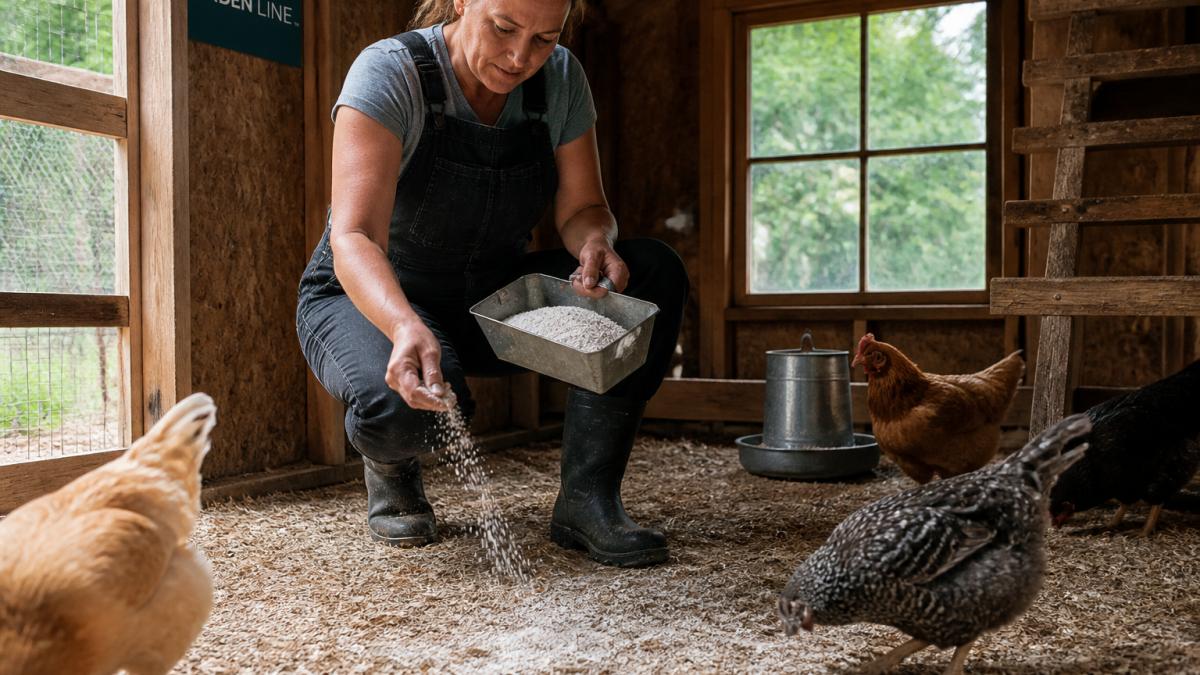
Natural coop odor control works when you apply the mineral in a thin, even layer across the whole floor, not in one heavy pile in a corner. Coverage beats volume every time, and the math is simple enough to plan a bag purchase around.
Application Rates by Coop Size
There is no single rate that fits every coop, because flock size, ventilation, and bedding type all shift the math. A practical starting point is a thin, visible layer across the floor rather than a measured scoop per bird.
| Coop Floor Area | Base Layer | Top-Up Between Changes |
|---|---|---|
| Up to 20 sq ft | About 2 lb | A light dusting every 1-2 weeks |
| 20-40 sq ft | About 3-4 lb | A light dusting weekly |
| 40-80 sq ft | About 5-8 lb | Weekly, heavier under roosts |
| Deep litter, any size | Mix 1 lb per 10 sq ft into litter | Every 2-4 weeks |
| Nesting boxes | A thin dusting per box | Weekly |
Those numbers are starting points, not prescriptions. Track how long a bag actually lasts in your coop, then size your next order from that, rather than from a guess.
Step-by-Step Application
- Clear the old litter and let the floor dry if it is damp.
- Spread a base layer of coarse granules across the whole floor, not just the corners.
- Add bedding on top, then a light sprinkle over the litter surface.
- Pay extra attention to nesting boxes and the spots under roosts, where manure concentrates.
- Reapply a light dusting whenever you notice smell returning or bedding feeling damp.
- Refresh the full layer at each bedding change.
Handling, Storage, and Precautions
Zeolite is a dust-generating mineral, so treat it like any fine powder. Wear a dust mask when pouring or refreshing, especially with fine grades, and work with the coop door open so fines clear rather than hang in the air. Keep the bag sealed between uses and store it off the floor in a dry spot; a damp bag cakes and loses effectiveness. Keep it out of reach of children and pets as a general handling rule, and wash hands after refilling.
Refresh Schedule by Coop Situation
| Coop Situation | Application Approach | Refresh Frequency |
|---|---|---|
| Small flock, well-ventilated coop | Light base layer plus top sprinkle | At each bedding change |
| Small flock, humid or closed coop | Heavier base layer, extra on roost areas | Weekly top-up between changes |
| Deep litter setup | Mixed into litter, not just on top | Every 2-4 weeks |
| Nesting boxes only | Thin dusting per box | Weekly |
Chicken Coop Moisture Absorber: Matching Pack Size to Flock Size
A chicken coop moisture absorber only helps if you buy enough of it, and pack size is where most first-time buyers guess wrong. The right quantity depends on your coop's floor area and how often you plan to refresh the layer.
As a rule of thumb, a small backyard coop with a handful of birds uses far less than a larger run or deep litter setup.
Arden Line's Chicken Coop Deodorizer comes in 12 lb and 24 lb sizes, so you can start small and scale up once you know your refresh rhythm.

Volcanic Rock Dust for Soil: The Same Mineral, a Different Job
Volcanic rock dust for soil uses the same family of material for a different purpose: improving soil structure rather than coop air. In the garden, the mineral's porous structure helps with drainage and aeration, and it holds onto nutrients and moisture that plants can use later.
For slow-draining beds, zeolite can help, but it works best as part of a broader fix. If your soil is compacted clay, the mineral alone will not solve it; you still need organic matter and aeration.
If you keep both chickens and a garden, a finely milled zeolite product doubles up nicely. Arden Line's Chicken Dust Bath is finely milled zeolite that works as a dust bath for poultry and small pets, and it is safe for chicks once they have developed feathers.

What to Compare When Buying a Coop Additive
Compare coop additives on five points: mineral type, granule form, pack size, durability, and packaging. Get those right and you will not need to switch products every few months.
- Mineral type: pure zeolite with a named mineral, not an unnamed blend
- Granule form: match the form to the job, coarse for bedding, fine for dust baths and soil
- Pack size: start with the smaller bag, then scale based on how long it lasts
- Durability: granules that resist crumbling track less and last longer
- Packaging: plastic-free options reduce waste and store well
On cost, cheaper options often cut the mineral with filler, which means you use more product to get the same result. The better question is cost per coop refresh, not cost per pound.
Conclusion
Getting coop odor and moisture under control takes the right mineral, the right granule size, and a refresh routine you will actually keep. Arden Line makes that straightforward with 100% natural volcanic zeolite that traps ammonia and moisture at the source, comes fragrance-free and chemical-free, and ships in plastic-free kraft packaging. Our Chicken Coop Deodorizer is available in 12 lb and 24 lb sizes, so you can match the bag to your flock. Add to cart and give your birds a drier, fresher coop.
Frequently Asked Questions
Is zeolite safe to use around chickens?
Yes. Zeolite is a naturally occurring mineral and Arden Line's coop additive is 100% natural zeolite with no perfumes, fragrances, or harsh chemicals. It is safe to use around your flock every day. Sprinkle it over coop floors, bedding, and nesting boxes, then reapply as needed and refresh with each bedding change. Because it works by trapping ammonia and moisture rather than masking odor, there is no chemical residue for birds to pick up while scratching.
How often should I reapply a coop additive?
Reapply whenever odor returns or bedding feels damp, and refresh the full layer with each bedding change. In a small backyard coop, most keepers top up between full cleanouts and replace the mineral layer when they swap bedding. A 12 lb box suits a small flock, while a 24 lb box lasts longer for larger coops or more frequent refreshing. Watch for damp patches under roosts, since those spots saturate first and signal it is time to add more.
Can volcanic minerals be used in garden soil too?
Yes. The same volcanic mineral sold as a coop additive also works as a soil amendment. Applied as volcanic rock dust for soil, it improves drainage, aeration, and nutrient retention, which helps potted plants and garden beds hold moisture without staying waterlogged. If your soil drains slowly, the mineral opens up pore space so water moves through instead of pooling. Use it in beds, containers, and raised planters alongside your coop routine.
Where can I buy natural zeolite for a chicken coop?
Buy from a supplier that states the mineral type, granule form, and pack size on the label. Arden Line sells a 100% natural zeolite coop deodorizer in 12 lb and 24 lb sizes, packaged in a plastic-free kraft box and bag, and a finely milled zeolite dust bath. Check for a stated mineral name such as clinoptilolite, a clear intended use, and packaging that keeps the product dry in storage.



Leave a comment
This site is protected by hCaptcha and the hCaptcha Privacy Policy and Terms of Service apply.